
Last updated on September 20th, 2026 at 01:26 pm
Large Language Models are now embedded in search, content workflows, analytics tools and marketing platforms. But before asking how to optimize for them, influence them or measure visibility inside them, there is a more basic question we need to answer:
What is the system actually doing?
That question sounds obvious, but many of the expressions we use in marketing hide very different technical events. “The model read our page”, “the assistant remembered our specification” and “the answer ranked our brand” may refer to retrieval, stored context, model parameters, source selection or generated output. Treating them as interchangeable makes both diagnosis and measurement harder.
This guide connects the technical explanations behind those distinctions. You do not need to become a machine-learning engineer to follow it. You need enough of the mechanism to know which part of the system you are observing, what can change it, and what the resulting evidence actually proves.
Start with the mechanism, then ask what it lets you control.
You do not need to memorize every equation. You do need to distinguish a parameter update from supplied context, a token score from a document rank, and a citation from evidence that the source supports the claim. The articles below build those distinctions progressively, with examples rather than shortcuts from architecture to marketing promises.


Enjoy Ad Free
Access the full Research Paper. For free.
This article is just an extract from the full 100 pages independent research I’ve written for Fuel LAB® Research over 4 years of analysis, studying LLMs models, and data collection.
The Model Is Only One Part of the System
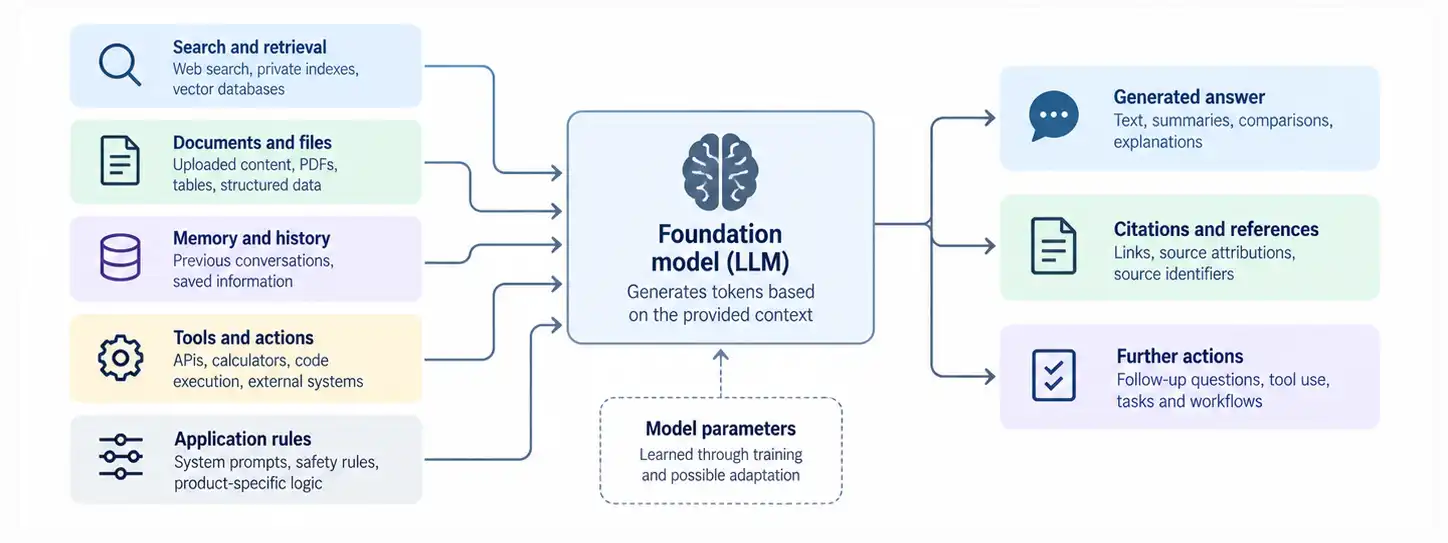
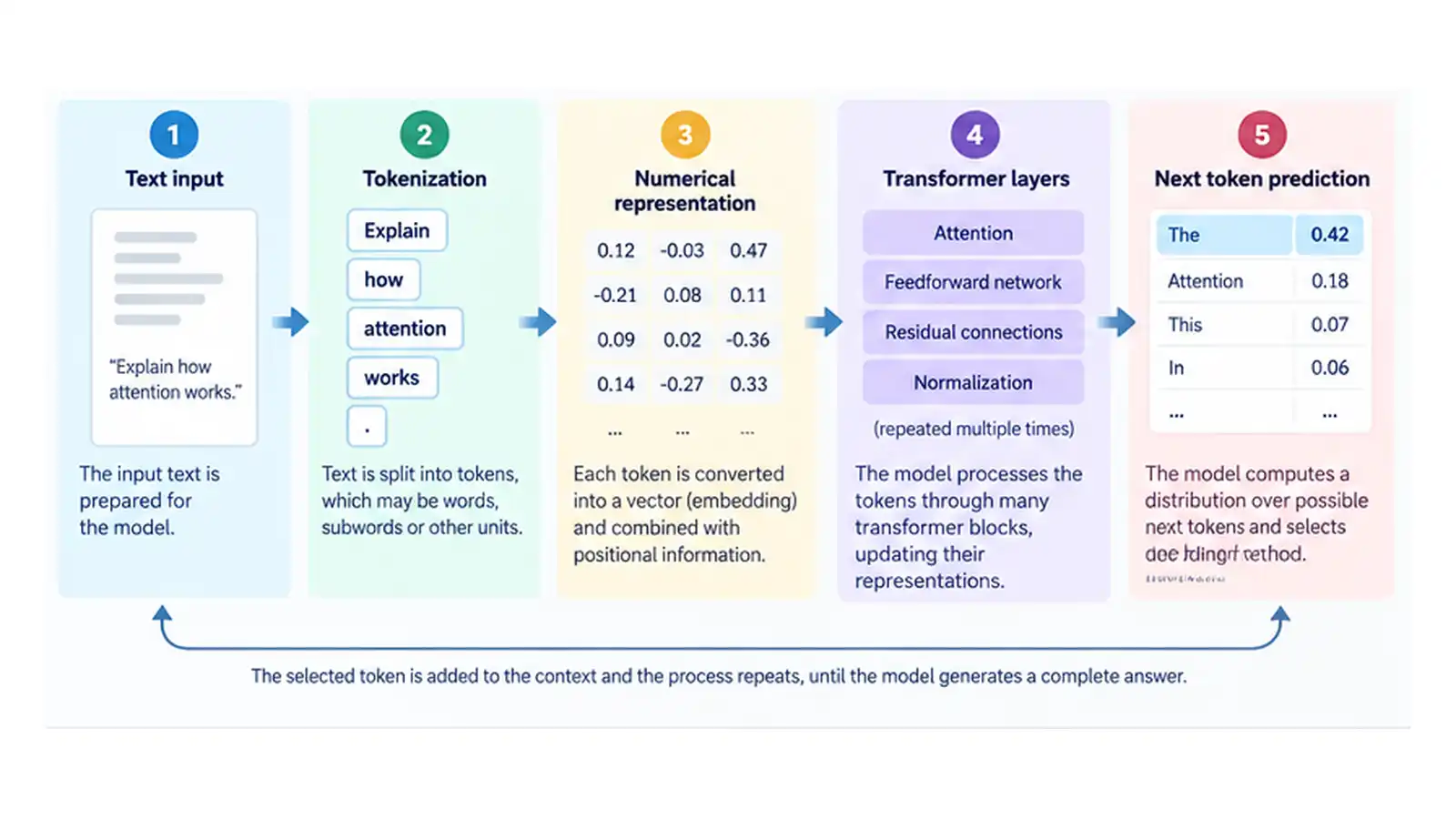
The reference architecture throughout this series is an autoregressive transformer language model. Given some context, it computes a distribution over possible continuations, selects a token according to the configured decoding process, adds that token to the context and continues.
That describes the model-level computation. It does not describe everything a modern AI product can do around it.
A product can connect the model to search, retrieval systems, uploaded documents, external memory, databases, tools and application-specific rules. Information used in an answer may therefore come from learned parameters, from the current conversation or from an external system consulted at runtime.
This distinction prevents two opposite mistakes. It is inaccurate to describe every AI assistant as nothing more than a frozen text generator. It is equally inaccurate to assume that every answer uses live search or that information appearing in an answer must have come from the public web.
The model and the complete information path are different levels of analysis. To understand an answer, we may need to inspect both.
Five Questions That Explain How LLMs Work
The technical series is easier to follow if we organize it around five practical questions rather than a vocabulary list.
1. How Does Training Change the Model?
Pre-training exposes a model to large numbers of examples and uses an optimization objective to adjust its parameters. Later fine-tuning, preference optimization or other adaptation can alter the model further.
But an ordinary conversation is not automatically another training step. Supplying a product specification in a prompt can change the answer immediately without changing the underlying model parameters. This difference between learning through parameter updates and using information supplied at runtime is one of the most important distinctions in the entire series.
2. How Does Language Become Computation?
The model does not receive sentences as the same linguistic objects we perceive when reading them. Text is first tokenized into processing units. Those tokens are represented numerically through embeddings and positional information, then transformed repeatedly as the network processes the context.
A token is not necessarily a word, and an embedding is not a dictionary definition. These are computational representations that allow the model to work with relationships inside the available context.
3. What Happens Inside a Transformer?
Transformer blocks combine several operations: attention, feedforward computation, residual connections and normalization. Modern architectures may add efficiency techniques such as expert routing or other variations.
These mechanisms are worth understanding because they explain how information is transformed during inference. But they do not justify simplistic mappings between architecture and marketing outcomes. The existence of attention does not give us an “attention SEO” formula; Mixture-of-Experts does not imply the existence of a marketer-accessible “marketing expert”; and proprietary models should not be assigned precise layer counts or internal structures without evidence.
4. Why Can a Fluent Answer Still Be Wrong?
Language fluency and factual reliability are different properties.
An answer can draw on learned associations, memorized material, supplied documents or retrieved evidence and still fail. The wrong source may be selected. A qualification may disappear during extraction. Two incompatible passages may be blended. A correct URL may be attached to a claim that the page does not actually support.
This is why factuality cannot be evaluated by asking only whether the model “knows” something. We need an appropriate reference and a comparison between the generated claim and the evidence that should support it.
5. What Can a Marketer Actually Change?
Once the previous layers are separated, the marketing question becomes much more precise.
A publisher can edit an owned page. A team may maintain a knowledge collection. An application developer can change retrieval or orchestration rules. An authorized operator may be able to adapt a model. A user can supply context for a specific task.
These are different interventions, with different audiences and persistence. The fact that one of them changes an answer does not mean the foundation model has globally “learned the brand”. And a technically successful intervention should not be reported as a commercial success until downstream evidence supports that conclusion.
Use the Technical Vocabulary to Diagnose Real Problems
The terminology becomes useful when something goes wrong.
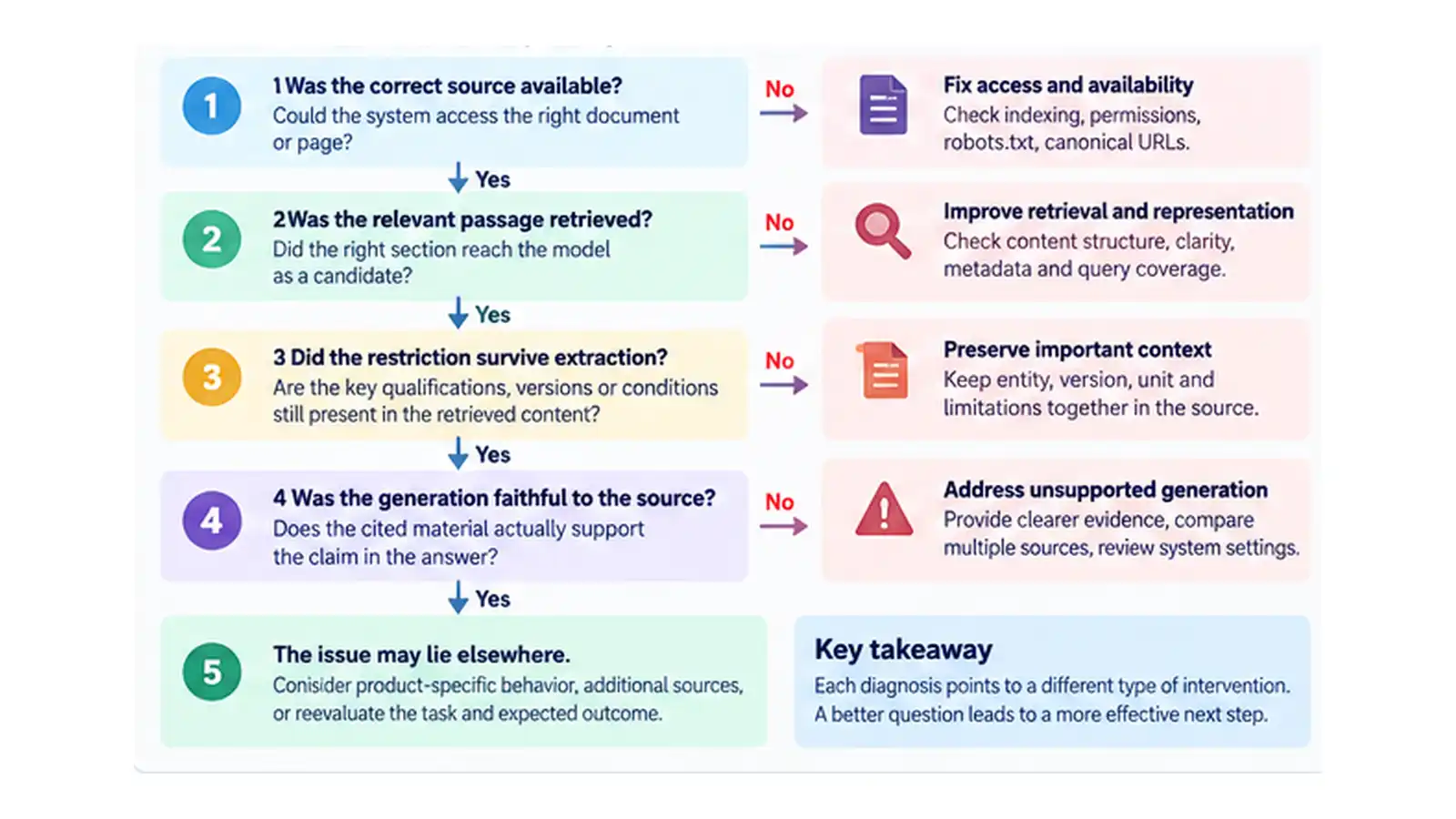
Suppose an AI answer assigns a feature to the wrong edition of a product. The instinctive reaction might be to rewrite the page, change the headline or add another FAQ. But none of those actions follows logically until we know where the error occurred.
A better investigation asks:
- Was the correct source available? If the system never had access to the right document, rewriting the final answer format is unlikely to solve the immediate problem.
- Was the relevant passage retrieved? The page may have been accessible while the decisive paragraph never entered the selected context.
- Did the restriction survive extraction? A sentence such as “Enterprise plan only” may become misleading if the product name survives but the plan qualifier does not.
- Did generation introduce an unsupported association? The evidence may have been available and still have been interpreted incorrectly.
Each diagnosis suggests a different intervention. That is far more useful than trying to derive a citation tactic directly from attention weights or token probabilities.
Capability Is Something You Test, Not Something You Infer from a Label
The same discipline applies when evaluating what an AI system can do.
If a configured system correctly compares two product specifications, that is a real capability demonstrated under the tested conditions. Saying that the underlying model is “only predicting tokens” does not invalidate the result; token prediction is part of the mechanism through which the result was produced.
But one successful result does not establish universal reliability either.
A useful test keeps the relevant conditions visible: the task, prompt, source access, product surface, tools, configuration, expected answer and acceptance criteria. Only then can repeated success or failure tell us something useful about the configured system.

The series discusses retrieval and supplied context where they clarify the research. It does not assume that every model supports the same modalities or that every product has the same tools. The wider current outlook on agentic systems belongs to a separate study. These pages explain the legacy research’s mechanisms and marketing boundaries.
How to Read the LLM Technical Series
Research context: adapted from AI-Optimized Marketing: Understanding and Influencing LLMs, edition 1.5.0-LEGACY — Frozen Outlook. The research addresses the 2023–2025 period; its evidence review and editorial revision are dated 17 September 2026. It is not a guide to the latest product defaults.
The articles below are accessible entry points to the full research, not replacements for its extended analysis and source trail. You can read them sequentially, or jump to the question that matches the problem you are trying to solve.
Start with the broader marketing and control boundaries:
- How LLM-Based Answers Are Changing Search Marketing — understand why representation, attribution, traffic and business outcomes need separate observation.
- Ranking in ChatGPT: What Search, Retrieval and Model Updates Actually Change — identify the component, audience and observable outcome before proposing an intervention.
Then move through the model itself:
- Inside LLMs: Pre-Training — training objectives, tokens and parameters, and the distinction between learning from examples and using supplied context.
- Inside LLMs: Neural Networks and Attention — numerical representations, positional information and attention.
- Inside LLMs: Understanding Transformer Architecture — how transformer blocks, residual connections, normalization, MLPs and selected-expert computation fit together, including the limits of the retained historical diagrams.
- Inside LLMs: RLHF, RLAIF, DPO and KTO — demonstrations, preferences, reward optimization and application controls, without converting answer style into an assumed website-ranking rule.
- Inside LLMs: Knowledge, Memorization and Factuality — why compression and memorization can coexist, what citation support actually means, and how to diagnose a misrepresented brand or product.
Finally, follow the model-level explanation into the information path itself: how sources are extracted and cited explains what can happen between publication and a generated answer, while the website-content guide develops the publishing implications.
TL;DR An AI system may receive a snippet, passage, table representation, file segment or other extracted object rather than the…
TL;DR AI-generated answers can move part of product discovery and evaluation into the search or assistant interface. That can change…
TL;DR To “Rank in ChatGPT” needs a defined meaning. Search results, retrieved passages, citations and positions in a generated list…
TL;DR Pre-training teaches a language model to predict the next token from context. Repeating that objective across enormous datasets changes…
Continue Reading LLM Pre-Training Explained: Tokens, Data & Model Weights
TL;DR Neural networks transform numerical representations through learned operations. Training changes parameters; ordinary inference uses those parameters to compute new…
TL;DR Post-training shapes model behavior after pre-training. Demonstrations, preference data, rewards, graders and application controls play different roles; the final…
Continue Reading Inside LLMs: RLHF, RLAIF & the Evolution of Model Alignment
TL;DR Fluency, factual correctness and faithful use of evidence are different properties. A polished answer can still confuse a product,…
Continue Reading Inside LLMs: why LLMs don’t really “know” things
TL;DR A transformer is a computational architecture, not a search index. Its internal operations explain how supplied representations are transformed;…
Continue Reading Inside LLMs: Understanding Transformer Architecture – A Guide for Marketers

Pietro Mingotti is an Italian neural science researcher, entrepreneur and technical marketing specialist, best known as the founder and owner of Fuel LAB®, a leading digital marketing and technical marketing agency based in Italy, operating worldwide. With a passion for science, creativity, innovation, and technology, Pietro has established himself as a thought leader in the field of technical marketing and data science and has helped numerous companies achieve their goals.