
Last updated on September 20th, 2026 at 03:00 pm
What does it actually mean to optimize a website for AI?
There are several different questions hidden inside that phrase. Can the relevant system discover the page? Can it retrieve the information needed for a particular question? Does the representation preserve the product, version and conditions that make the answer correct? Does the generated answer use that evidence faithfully? Is your website visibly cited? Does anyone visit—and does that visit create business value?
Those outcomes are connected. They are not interchangeable.
That distinction is the useful starting point for “SEO for AI”. It prevents us from turning one crawler visit into an “AI impression”, one citation into a conversion, or one successful prompt into a universal ranking theory.
My starting point is therefore the marketing problem, not the acronym. An AI-generated answer can resolve part of a user’s question before they visit a website. A brand can be discussed without its own domain being cited. A page can also contribute evidence to an answer without becoming the visible link the user sees.
That makes discovery, representation, attribution, traffic and commercial outcome separate things to investigate. It does not establish that every decline in organic traffic was caused by AI, nor that every traditional SEO tactic now guarantees inclusion in an AI answer.
For the technical and strategic perspective I bring from Fuel LAB®, the useful response is to connect content quality, delivery and measurement.
So the practical question is not simply “How do I get ChatGPT to recommend my website?”
It is:
For which user need, through which product and information path, using which evidence, and with what observable outcome?
A product recommendation, a factual quotation, a citation in a sources panel and an attributed referral are different events and need different evaluations.
Editorial scope — 20 September 2026. This is the practical closing article of the research series AI-Optimized Marketing: Understanding and Influencing LLMs, edition 1.5.0-LEGACY — Frozen Outlook. The research itself examines the 2023–2025 search-to-answer transition; product-specific maintenance notes in this article have been rechecked against current documentation. This is an explanatory review, not a report of a new Fuel LAB® experiment.
How AI Systems Find, Use and Cite Web Content
Start by separating the language model from the product and information systems around it.
A model can generate from information encoded in its parameters and from information supplied in the current context. A search-enabled product can retrieve external material and add it to that context. A tool-enabled or agentic product can obtain information through still other routes.
Updating a webpage is therefore not the same operation as updating model weights, and retrieving a passage does not mean the model has permanently learned it.
The research architecture described in Lewis and colleagues’ Retrieval-Augmented Generation work makes the conceptual distinction concrete: parametric knowledge and an external document collection are different information routes.
Current products add their own implementation details.
OpenAI’s current ChatGPT Search documentation states that web search can work with third-party search providers and can reformulate a user request into one or more targeted search queries, sometimes issuing additional searches after reviewing initial results.
That is useful documentation of one product behavior. It is not evidence that every response uses search, issues a fixed number of queries or follows an identical retrieval pipeline.
Google’s current guidance for generative AI features in Search similarly describes both retrieval-augmented generation over its Search index and query fan-out, in which related searches can be generated to investigate different parts of a question.
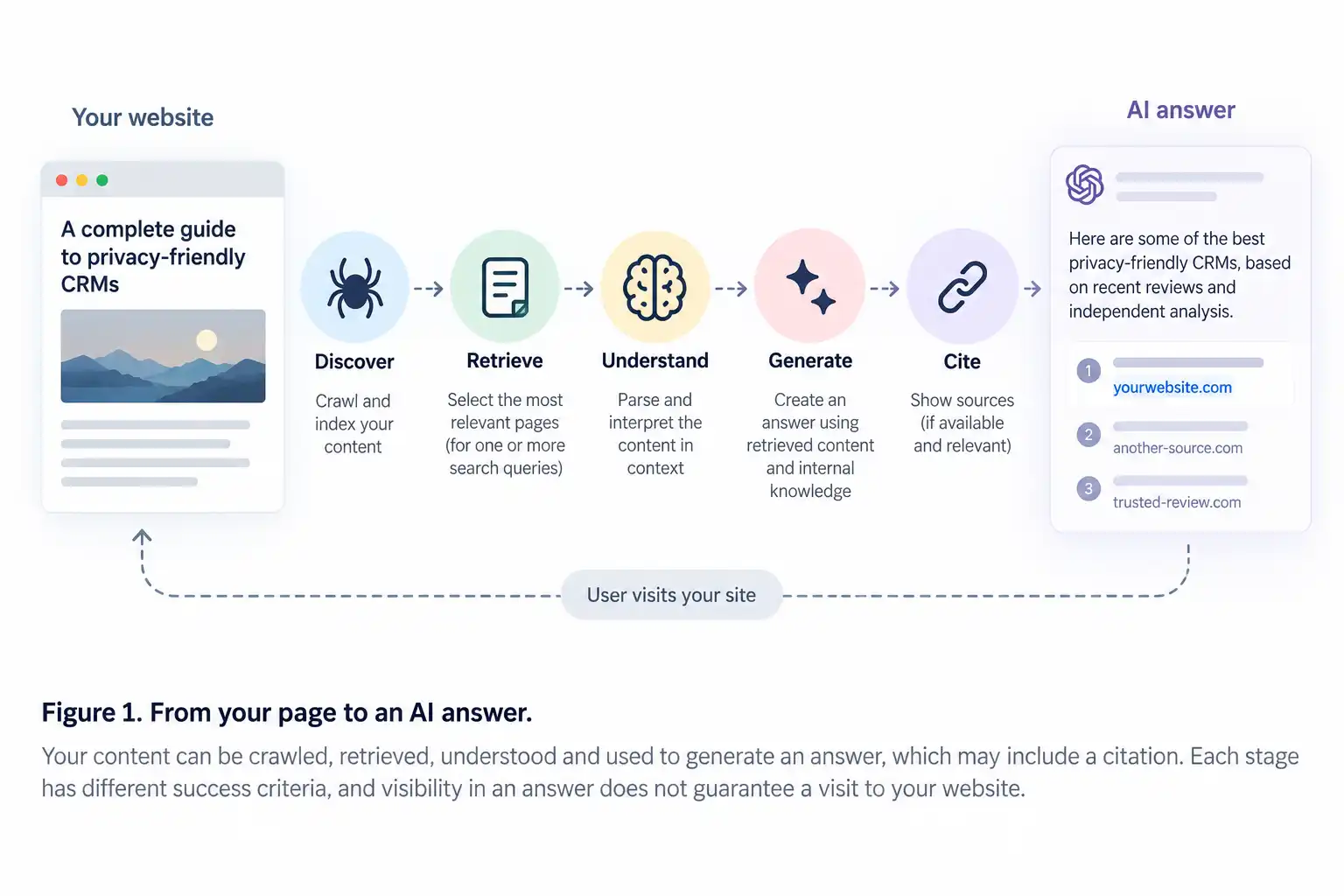
The lesson is not “AI search always decomposes a prompt”. It is that the path from the user’s question to the source material may contain additional retrieval and ranking stages that need to be observed rather than guessed.
- Discovery and retrieval come first. In Google Search’s generative AI features, Google currently states that an eligible supporting page must be indexed and eligible to appear with a snippet. OpenAI currently recommends allowing OAI-SearchBot if you want site content to be eligible for inclusion in ChatGPT Search summaries and snippets. Neither provider guarantees ranking or selection simply because the technical requirements are satisfied.
- Fetching has different purposes. OpenAI’s crawler documentation distinguishes OAI-SearchBot for Search from GPTBot for content that may be used in foundation-model training. ChatGPT-User is used for certain user-triggered actions and is not OpenAI’s automatic Search crawler. These controls are intentionally separate.
- Selection is not citation. A system can discover a page, retrieve it, extract a passage, use some of its information and still cite something else. Conversely, a displayed citation can fail to support the proposition placed beside it.
- “Readable” depends on the route being tested. A browser, a search renderer, a crawler and a text extraction system do not necessarily receive the same representation. Google documents crawling, rendering and indexing as distinct stages. Do not convert Google’s rendering capabilities into an assumption about every other system.
TL;DR — Make the source accessible, make the claim supportable, and measure the right event.

Technical SEO can influence discovery and delivery. Clear, sufficiently detailed content provides usable evidence. Neither guarantees selection, recommendation or citation. Keep search access separate from training permission, and never report a crawler request as though it were an answer impression.
Technical SEO: Discovery and Delivery Before Citation
Technical SEO has not become irrelevant because some search experiences now generate answers.
Where the information path depends on a search index, crawl or fetch, technical access still determines whether the material is available for later stages. Google’s current guidance is unusually explicit on this point: its generative AI Search features rely on core Search ranking and quality systems, and established technical SEO practices remain relevant.
The useful diagnostic question is where the information path failed: discovery, access, rendering, extraction, retrieval, source selection, generation or citation.
Fixing one stage is valuable. It does not prove success at every stage after it.
I use OSE — Organic Search Engineering to describe the broader work around organic discovery: technical delivery, semantic content, measurement and commercial purpose. The useful part of that perspective is the connection between systems. It is not a claim that one discipline, framework or checklist controls every generated answer.
For important pages, I would work through the following sequence.
- Check the search route that actually matters. Use the search engine’s own inspection and webmaster tools to investigate indexing, sitemaps, canonicals and accidental exclusions. Bing visibility matters when Bing is part of the route being studied; it is not a universal admission requirement for every ChatGPT response. Where appropriate, IndexNow can notify participating engines that a URL changed, but notification is not a guarantee of immediate crawl, indexation or ranking.
- Choose access policy by purpose. OpenAI currently lets publishers control OAI-SearchBot and GPTBot independently. A site can therefore allow Search crawling while disallowing potential training collection. ChatGPT-User covers certain user-triggered requests and, because those requests are user initiated, robots.txt may not apply in the same way. Establish the policy deliberately instead of placing every AI user agent into one undifferentiated allow/block rule.
- Test what is actually delivered. Check status codes, redirect chains, canonical destination, authentication, WAF challenges, rate limits and the response body. A `200 OK` containing an anti-bot challenge or login page does not mean the article itself was successfully delivered.
- Verify the representation, not just the browser view. Important product names, versions, units, limitations and table labels should survive the route being tested. Keep images and diagrams where they add information; do not remove useful visual content simply because text is easier to extract.
- Distinguish server rendering, client rendering and hydration. Server-rendered HTML and a JavaScript shell are different starting points. Hydration adds interactive behavior to existing markup. A collapsed accordion is not automatically inaccessible; what matters is whether the content exists in a representation the target workflow can obtain.
- Use structured data for what it actually does. Google’s current AI optimization guidance explicitly says that no special structured-data markup is required for generative AI Search. Continue using supported structured data when it accurately describes the page and serves an established Search purpose. Do not present schema markup as a hidden prompt to ChatGPT or Google AI.
- FAQ content can still be useful; the Google FAQ rich result is gone. Google stopped showing FAQ rich results on 7 May 2026 and later removed the corresponding documentation. Retain useful FAQs because they help readers and content organization—not because
FAQPageis expected to create that former enhancement. - Represent the actual entity and page type. Article, Product, Organization and other schema types describe different objects. Select an applicable type and supported properties rather than marking an explanatory page as something it is not.
- Keep authorship and dates truthful. Distinguish publication from meaningful revision. A new date should not be manufactured merely to simulate freshness.
- Keep structured data and visible content consistent. A machine-readable field does not compensate for a missing or contradictory explanation on the page.
- Validate each claimed outcome separately. Valid markup, eligibility for a Search feature, inclusion in an AI answer and a business conversion are four different observations.
- FAQ content can still be useful; the Google FAQ rich result is gone. Google stopped showing FAQ rich results on 7 May 2026 and later removed the corresponding documentation. Retain useful FAQs because they help readers and content organization—not because
At the end of this technical audit you should be able to demonstrate something precise: the intended content is accessible through the route you tested—or identify exactly why it is not.
You still have not demonstrated that a particular external system will select or cite the page. That is the next problem.
SEO and AEO: Shared Foundations, Different Outcomes
One persistent shortcut in the AI-search debate is that “LLMs generate, therefore they cannot rank”. That is false.
Ranking is a task. An LLM can be asked or trained to judge relevance and order candidate passages. Sun and colleagues’ RankGPT research is a concrete example.
What does not follow is that every commercial assistant uses that method, or that its answer-generation model is also responsible for crawling and initial candidate retrieval.
Google now states its own position very clearly: for Google Search, optimizing for its generative AI experiences is still SEO, because those features rely on the company’s core Search ranking and quality systems. The labels AEO and GEO are therefore not separate technical requirements inside Google Search.
Across the wider market, however, “AEO” can still be useful shorthand if it names work that ordinary rank tracking does not capture—for example answer representation, citation support, sampled prompt monitoring and factual-error review.
The problem begins when a new acronym is used to imply a universal optimization layer that has not actually been demonstrated.
Cover the question deeply enough to resolve it. A good guide explains the mechanism, the conditions under which its advice applies, evidence, examples and failure modes. A useful product page makes both the offer and its limitations inspectable.
Neither task has a universal word count.
A 2,000-word article can be comprehensive or padded. A 200-word answer can be precise or omit the only exception that matters. Google’s current AI optimization guidance explicitly says there is no ideal page length and no need to split pages into tiny fragments merely for AI.
Expand for Technical Explanation
- What mechanistic relevance research actually tests. Liu, Mao and Wen (2025) investigate relevance judgments using activation patching. Their experiments examine how internal model states contribute to relevance judgments under defined pointwise and pairwise tasks.
That is evidence that relevance can be studied mechanistically inside a model. It is not evidence that an H2, a longer paragraph or a more assertive tone causes a commercial answer engine to cite a webpage. The editorial intervention and the observed source-selection outcome still require their own test. - Ranking is a task, not a contradiction. RankGPT uses an LLM to reorder candidate passages after candidate material already exists. That is distinct from crawling the web, retrieving the initial candidate set and deciding which claims in a final answer receive citations.
Answer the central question early, then earn the reader’s confidence with the explanation.
I recommend a direct opening because it helps a reader immediately understand what the page can resolve. Keep important qualifications beside that answer, then use the body to explain the mechanism, evidence, examples and exceptions.
This is an editorial decision, not an architectural claim that the first paragraph receives an attention bonus.
Expand for Technical Explanation
- How retrieval-augmented generation changes the problem. The 2020 RAG paper by Lewis and colleagues combines retrieval from an external document collection with generation. The important editorial distinction is between your source document and the representation eventually supplied to the generator.
If extraction removes a table heading, product version or negation, the supplied passage may no longer express the original fact correctly. Repairing that source or extraction problem is directly observable. It does not prove that the retriever will select the page next time. - A reference is not a warranty. The ALCE benchmark evaluates answer quality and citation support separately. The 2025 SourceCheckup study provides another domain-specific example of citation-support failures in medical question answering.
The practical audit is claim-level: open the cited source and check whether it supports the proposition and its conditions. A correct URL beside “available on every plan” does not fix the statement if the source says “Enterprise only”.
Structure content for meaning, not for an imagined neural checklist.
Use headings to identify genuine subjects, tables for properties that are actually comparable, lists for distinct steps, and prose for relationships that require explanation.
Keep an entity, version, value, unit and important restriction close enough that both a reader and an extracted representation can preserve their relationship.
Consider the fictional CRM Northline. “Export available” is not enough to answer many buyer questions. “Northline Standard v2 exports contacts as CSV; audit-log export is available only on Enterprise” preserves the company, edition, object, format and restriction.
That is not keyword repetition. It is information design.
Expand for Technical Explanation
From document structure to model input. A retrieval workflow may supply a complete document, selected passages, snippets, structured objects or another representation. Extraction can preserve headings and table labels—or detach them. Those are properties of the implementation, not universal consequences of HTML.
In the Northline example, extracting “CSV — included” without the “Standard v2” heading or column label creates an ambiguous piece of evidence. Inspect both the human page and the representation that the system actually receives.
Google’s current generative AI optimization guide explicitly says its systems do not require content to be broken into tiny chunks and that there is no ideal page length.
Make expertise inspectable rather than theatrical.
Name the author where authorship matters. Explain the method behind a test. Distinguish an experiment from a literature review. Use sources where they support the actual claim and acknowledge meaningful uncertainty.
Google’s people-first content guidance discusses experience, expertise, authoritativeness and trustworthiness while also making clear that E-E-A-T is not one discrete ranking factor.
That should discourage another common mistake: removing qualifications or writing with artificial certainty merely to appear “authoritative”.
Expand for Technical Explanation
What citation bias does—and does not—tell us. Algaba and colleagues’ 2025 study examined scientific references suggested by GPT-4o from paper metadata and abstracts without search or retrieval augmentation. The study found differences between generated and human reference selections, including preference for already highly cited work.
That is evidence about academic-reference generation under a particular experimental setup. It is not evidence that a commercial AI search product gives your website a citation bonus because the prose sounds scholarly.
Use references to make claims auditable. Huang and Chang’s position paper on responsible citation argues for traceability and accountability in LLM outputs. The rationale is valuable, but it is not an SEO uplift experiment.
Use a reference because it supports the nearby claim at the level of precision you assert. A domain-specific experiment should not silently become a universal statistic about all AI search products.
Write for someone who needs to make a decision.
“Human-friendly” should mean understandable, useful and accountable—not superficial. Preserve technical language when it adds precision, define it where necessary, and use examples when they make an abstract mechanism inspectable.
An article can be approachable without being simplistic.
Expand for Technical Explanation
A practical extraction test. Read a consequential passage outside the rest of its page. Can you still identify the entity, plan, feature, unit and exception?
Now compare it with the representation produced by the extraction route you are testing. If a row has become merely “CSV — included”, determine whether the labels that make the claim safe to interpret survived.
This is a proposed editorial and technical test—not a reported Fuel LAB® result and not a guarantee of improved citation. A separate experiment is required to test generated answers under recorded conditions.
This leads naturally to query design.
A useful source does not have to repeat a user’s complete question verbatim. It needs to contain the information necessary to resolve the question. Before choosing keywords, distinguish the user’s prompt from any search queries a product may issue internally.
Long-Tail Keywords, Search Queries and n-Grams
These terms are often collapsed into one another, but they describe different things.
- A prompt is the user or application input supplied to an assistant.
- An issued search query is a request sent to a search service.
- An n-gram is a sequence of n units, such as words or tokens, depending on the analysis.
- Long-tail describes the lower-frequency region of a demand distribution, not a phrase containing an arbitrary minimum number of words.
A long phrase can be common. A two-word phrase can be extremely rare. Query length and demand are different measurements.
AI Search Queries Can Be Rewritten, Expanded or Split
Take the original example:
“How do I optimize my WordPress site to be recommended by ChatGPT when someone asks about privacy-friendly CRMs?”
A search-enabled product could investigate parts of that request using searches such as:
WordPress content crawlability JavaScriptCRM privacy data export retention documentationChatGPT Search publisher inclusion requirements
These are illustrative possibilities, not a captured ChatGPT trace.
OpenAI currently documents that ChatGPT Search can reformulate a request into one or more targeted queries for search providers and can issue additional queries after seeing earlier results. Google documents query fan-out in its own generative Search features.
Neither statement establishes a universal query count or ideal query length.
- Product documentation: OpenAI’s Search documentation documents request reformulation and additional searches; Google documents query fan-out. Treat those as product-specific capabilities.
- Research: Jagerman and colleagues’ Query Expansion by Prompting Large Language Models evaluates an explicit query-expansion method on retrieval benchmarks. It shows that LLM-assisted expansion can be studied experimentally—not that every consumer AI search product always shortens prompts into a particular query template.
What Should You Optimize For?
Optimize for the relationship between a recognizable subject and the evidence required to answer an actual question.
The distinction below is about content design—not an attempt to reconstruct hidden reasoning or search demand from phrase length.
| Query or Input Unit | What It Tells You | Content Response |
|---|---|---|
A recognizable topic or entity phrase, such as CRM CSV export | Identifies a subject, but does not by itself establish demand, intent or eligibility for recommendation. | Use accurate terminology in titles, headings and explanatory copy. Make the company, product, version and capability unambiguous. |
| A constrained question, such as “Does Northline Standard v2 export audit logs?” | Defines a decision and its conditions. Its length does not determine whether it belongs to the long tail. | Resolve the specific question and preserve the exception: contact CSV export and Enterprise-only audit-log export are different capabilities. Keep the evidence close to the claim. |
A broad page can explain a category while a focused documentation page resolves one specific capability. Those resources should complement each other.
Creating large numbers of near-duplicate pages for minor query variations does not create evidence that was not already there. Google’s current guidance specifically warns against producing many pages mainly to capture query or fan-out variations.
- Use stable terminology and explicit relationships. Identify company, product, edition, feature and limitations accurately.
- Develop complete answers. Include examples, comparison dimensions and material exclusions when the decision needs them.
- Use page elements for their real purpose. Descriptive headings, useful link text and accurate image alt text improve communication and accessibility. They are not containers for speculative AI-search keywords.
Keywords have not disappeared. They simply sit inside a larger problem involving entities, evidence, intent and the information path.
Useful Tools, Measurement and Proposed Standards
Tools are useful only when they help answer a defined measurement question.
Can the intended system access the page? Across a repeatable panel of prompts, is the brand represented accurately? Is your domain cited? Does the cited source actually support the claim? Do observable visits convert?
No single “AI visibility score” should silently stand in for all of those outcomes.
The vendor resources below are examples, not a comparative product test or purchase recommendation. Before using one, ask which interfaces it samples, how prompts are selected, what its denominator is, whether location and language are controlled, how often tests repeat and whether you can inspect the underlying answers.
- Answer monitoring: Peec AI and Ahrefs Brand Radar describe products for monitoring brand presence and sources in generated answers. Use these observations to identify patterns worth investigating—not as population-level impression counts.
For an internal monitoring panel, fix the question set, language, market assumptions, product surface and collection period. Record brand mention, recommendation role, own-domain citation, competing citations and factual correctness separately. - Log analysis: platforms such as Oncrawl can help inspect server request data. Logs can establish access attempts, URLs, response codes and timing. A crawler hit is still not a human impression, a citation or a business outcome.
Expand for in-depth Workflow
Build a measurement chain without inventing the missing links. Keep access events, answer observations, referrals and business outcomes in separate fields:
- Access events are not AI impressions.
First establish which requester asked for which URL and what was returned. OpenAI currently distinguishes OAI-SearchBot from user-triggered ChatGPT-User requests and from GPTBot training collection. These events have different purposes.- OAI-SearchBot: a verified request shows Search crawler access. It does not prove selection or display in a particular answer.
- ChatGPT-User: a verified request can indicate a user-triggered page visit. It does not prove that the URL became a visible citation or that all fetched content influenced the answer.
- GPTBot: this is a separate signal concerning content that may be used in foundation-model training, not ChatGPT Search visibility.
- Use platform exposure data when the platform provides it.
Google announced dedicated generative-AI performance reports in Search Console on 3 June 2026. As of 31 August 2026, Google says those insights have been rolled out to all websites worldwide. The reports provide dedicated views of URL impressions within generative AI features in Search and Discover, including AI Overviews and AI Mode.
Use those platform measurements when answering a Google-specific exposure question instead of substituting crawler requests for impressions. - Track actual referrals separately.
OpenAI’s current publisher guidance states that ChatGPT addsutm_source=chatgpt.comto referral URLs from ChatGPT search results. Preserve the actual referral and campaign evidence your analytics receives rather than assuming every ChatGPT-originating session will appear through one universal attribution pattern. - Use denominators that survive inspection.
Suppose 100 monitoring attempts generate 85 usable answers and 35 of those cite your domain. That is 41.2% among usable answers, 35% of attempted requests and an 85% completion rate. Each number answers a different question.
Also distinguish “domain cited” from “citation correctly supports the associated claim”. These are illustrative calculations, not Fuel LAB® performance results.
llms.txtis a proposal, not a ranking or access-control standard. The llms.txt proposal is currently at version 2, modified on 10 August 2026. It describes a Markdown resource map intended to help agents consume websites and documentation.
That can be useful for systems that deliberately support it. It does not prove adoption by an unrelated product. Google’s current guidance is explicit: Google Search does not need or usellms.txtfor Search visibility, and maintaining one neither helps nor hurts Google Search rankings. Treat it as an optional resource interface with an identifiable consumer—not as a substitute for robots.txt, a sitemap or authoritative public documentation.- Small inspection utilities can be useful—with boundaries. The following tools expose information available through their supported interfaces; they are not warrants for claiming access to complete private reasoning.
- Mike Friedman’s ChatGPT Search Query and Reasoning Extractor: a published utility for inspecting exposed query and source information. Treat the word “reasoning” as the tool author’s label, not evidence of access to a complete internal chain of thought. Current compatibility should be verified before use.
- Julian Redlich’s BetterGPT: a third-party browser extension described for inspecting query and source information. Review current permissions, implementation and compatibility before using it in an authenticated session.
- Firecrawl’s llms.txt generator: a utility for generating the proposed resource-map file. Review generated summaries and links manually. Creating the file is not evidence that a target service consumes it.
- Other monitoring products can be evaluated against the same measurement requirements:
- Profound: describes answer visibility and citation analysis. Ask whether underlying sampled answers can be inspected and how its scores are constructed.
- Unify AI SEO Ranking: describes monitoring of mentions and domain references. Treat a report as a snapshot under its stated collection conditions.
- Peec AI: describes prompt and source monitoring. Evaluate whether its markets, prompt design and repeatability match the decisions you need to make.
- Rankscale: describes AI-answer visibility tracking. Confirm how it distinguishes mentions, citations, answer positions and factual correctness before comparing its metrics with another platform.
Conclusion and Key Takeaways
SEO for AI becomes much more useful once we stop looking for one hidden switch.
Search infrastructure determines whether information can enter some candidate pools. Technical delivery determines what those systems can obtain. Content determines what your source actually says. Retrieval and generation determine which evidence is used and how. Citation determines what becomes inspectable to the reader. Analytics and commercial systems determine whether any of that created a visit, lead or sale.
No single metric represents the entire path.
The practical priorities are therefore:
- Resolve real access and delivery failures. Check the route that actually matters and keep Search access, user-triggered access and training permissions conceptually separate.
- Make consequential facts easy to identify and verify. Preserve product, edition, scope, unit, date and important restrictions.
- Preserve depth and context. Answer the question early when useful, then retain the explanation that makes the answer trustworthy. Shorter is not automatically better.
- Make expertise and sourcing inspectable. Distinguish provider documentation, external research, proposed practice and your own observed experiment.
- Test extraction and generated representation. A technically available page can still lose meaning on the path to the answer.
- Measure access, answer presence, attribution, visits and business outcomes separately. Keep the denominator and collection conditions visible.
- Treat platform-specific guidance as platform-specific. Google Search, ChatGPT Search and other products do not expose one universal AI-search protocol.
This is also where the LEGACY research reaches its natural boundary.

Pietro Mingotti is an Italian neural science researcher, entrepreneur and technical marketing specialist, best known as the founder and owner of Fuel LAB®, a leading digital marketing and technical marketing agency based in Italy, operating worldwide. With a passion for science, creativity, innovation, and technology, Pietro has established himself as a thought leader in the field of technical marketing and data science and has helped numerous companies achieve their goals.