
Last updated on September 20th, 2026 at 01:44 pm
TL;DR
- AI-generated answers can move part of product discovery and evaluation into the search or assistant interface. That can change when a user visits a website, but it does not eliminate the value of search or the publisher’s site.
- Ranking, mention, citation, referral and conversion are different events. A brand can appear without being cited, be cited without receiving traffic, or receive traffic without producing commercial value.
- The model is not the whole product. Search, retrieval, uploaded files and other permitted context can supply information to the same interface through different paths.
- Query fan-out can expand one complex request into related searches. It is a documented behavior in some systems, not a universal rule that every LLM converts every prompt into a fixed set of short queries.
- SEO still matters when search mediates access to information. Crawlable, accurate and clearly structured sources improve the information environment, but do not guarantee citation or recommendation.
- Measure AI visibility and business impact separately. Prompt-panel visibility, referral traffic, qualified leads and revenue answer different questions and should not be collapsed into one score.
Search marketing has always connected an information need with a discoverable result and, ideally, a useful next action. What is changing is where some of the reading, comparison and evaluation now happens.
On a conventional search results page, the user sees a list of links, chooses a source and then starts evaluating what it says. An AI-generated answer can perform part of that work before the visit: summarizing several sources, comparing products, extracting requirements or presenting a recommendation directly inside the interface.
That creates a genuine change in the search journey. But it does not mean search rankings have stopped mattering, websites have become unnecessary or every decline in organic traffic can be attributed to AI.
In fact, the measurement problem becomes more important precisely because there are now more stages between discovery and commercial outcome.
A search position does not automatically create a click. A click does not automatically create a qualified visit. A brand mention inside an AI answer does not automatically mean the brand’s website was used. And a citation does not automatically produce revenue.
The important shift is not that “search has disappeared”. It is that source discovery, answer construction and user evaluation can now happen at different points in the journey. The marketing task is to identify which point changed—and what evidence actually demonstrates the effect.
This article looks at that shift through the revised research without treating every new AI interface as a replacement for traditional search, or every traffic movement as evidence of an AI effect. The practical questions remain much more concrete:
- Were we included?
- Were we represented correctly?
- Were we credited?
- Did the user visit?
- And, ultimately, were we chosen?
Those questions belong to the same customer journey. They are not the same metric.
Research context: adapted from AI-Optimized Marketing: Understanding and Influencing LLMs, edition 1.5.0-LEGACY.


Enjoy Ad Free
Access the full Research Paper. For free.
This article is just an extract from the full 100 pages independent research I’ve written for Fuel LAB® Research over 4 years of analysis, studying LLMs models, and data collection.
From Search Results to Constructed Answers
A conventional search results page delegates most of the evaluation to the user. You scan the results, select a source, read it, compare it with other material and decide what applies.
That process consumes two scarce resources: time and attention.
A generated answer can compress part of the same work. Instead of presenting only candidate links, the system may retrieve information from several sources and construct a response before the user opens any of them.
That can be extremely useful when the answer preserves the evidence and the user’s requirements. It can be equally problematic when the synthesis removes a limitation, mixes product editions or relies on an outdated third-party description.
Consider a simple supplier-selection example. A company needs a service that supports two warehouses, includes an approval workflow and integrates with an existing system.
In a traditional search journey, the buyer may open several provider pages and compare those requirements manually. An AI-generated answer may instead build a shortlist, summarize each provider and immediately state which products appear to satisfy the requirements.
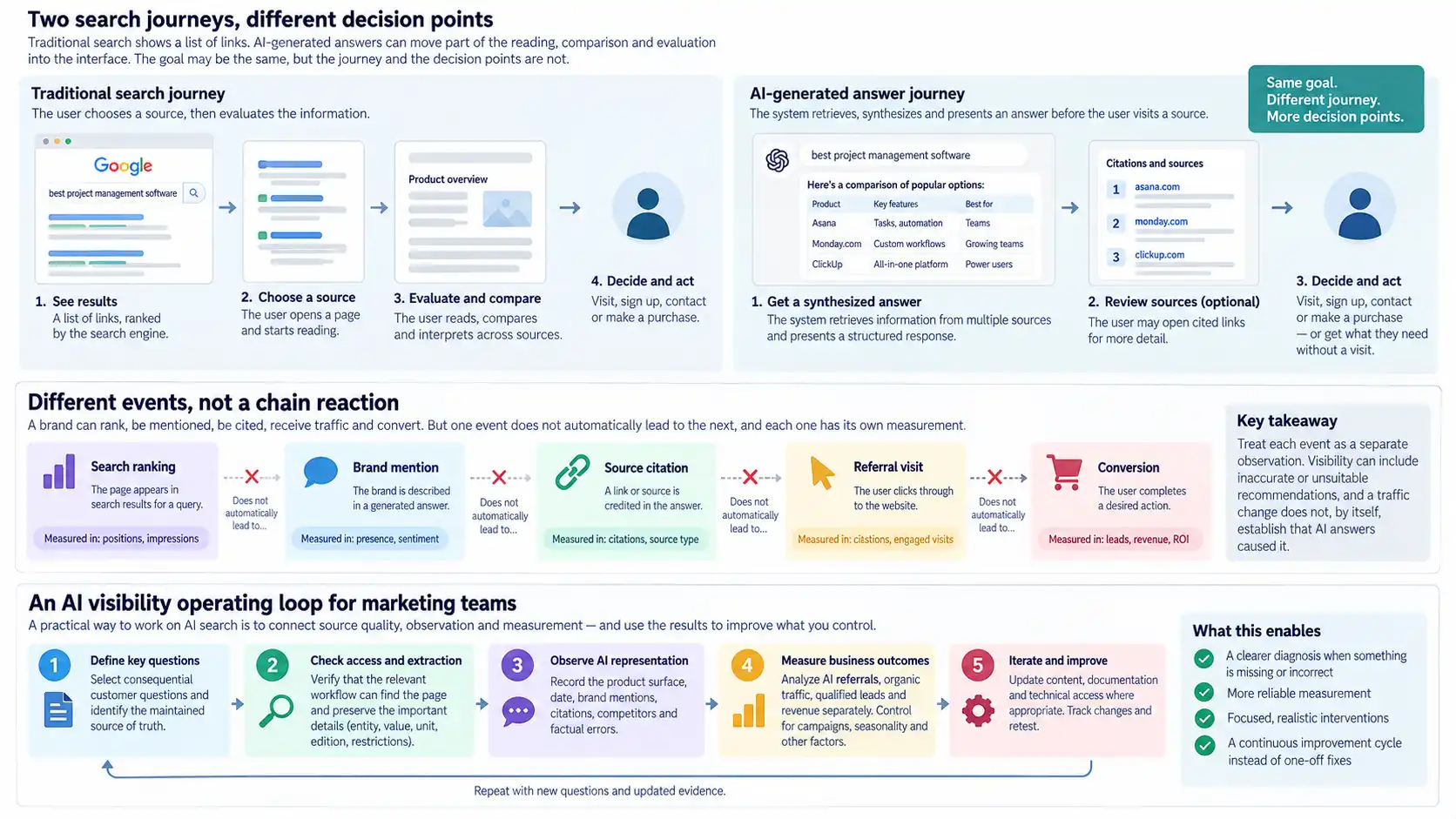
Traditional search asks the user to evaluate a ranked list of sources; AI-generated answers can move part of that comparison and interpretation into the interface before the click.
That does not simply move a ranking from Google into an assistant. It creates a different object: a constructed answer assembled from whatever information path the product used.
A place in a generated answer is not the same thing as a position in a search results page. A provider might be recommended, cited as evidence, rejected as unsuitable or confused with another company. Calling all four outcomes “visibility” removes the context that makes the observation useful.
This is also why an absent brand does not tell us what went wrong.
The correct source may never have entered the collection. It may have been available but not retrieved. The right passage may have been retrieved and then misinterpreted. The product may genuinely fail one of the buyer’s requirements. Or the answer may have been generated without consulting the public web at all.
Those cases look identical if the only metric is “brand absent”. Operationally, they require completely different responses.
A useful measurement model begins by separating three layers:
- Representation: did the brand or product appear, in what role, and with which claims? A positive description is not useful if the description is factually wrong.
- Attribution: which source was linked, and does that source actually support the statement? A third-party review citing your brand is not the same event as a referral to your owned website.
- Response: did the user visit, submit an inquiry, purchase or perform another observable action? Those outcomes require their own analytics and business data.
These layers can influence one another, but they should not be collapsed into one metric. A useful AI answer can send a reader to detailed documentation. Another can completely satisfy a simple informational need without a visit. A third can prominently cite a legitimate page and still describe the company incorrectly.
The marketing analysis needs to preserve those differences.
AI Summaries, Zero-Click Search and What the Click Actually Means
The easiest story to tell about AI search is that generated summaries take the answer away from publishers and therefore remove the click.
Sometimes they do remove the need for a visit. But that is not the only possible outcome.
A short definition can be fully answered inside the interface. A complex implementation problem may still require the original documentation. A product comparison may eliminate some exploratory clicks while creating a much stronger reason to visit one shortlisted provider.
So “zero click” describes an observable interaction pattern. It does not, by itself, tell us whether the user was satisfied, whether the publisher lost economic value, or whether a later visit occurred through another route.
The revised research therefore separates aggregate observations from forecasts for an individual business.
Pew Research Center’s July 2025 analysis examined Google browsing activity from March 2025 among 900 U.S. adults. In the observed sample, users clicked a traditional search result in 8% of visits where an AI summary appeared, compared with 15% of visits without one. Links inside the AI summary were clicked in 1% of visits where a summary appeared.
Those figures are useful. They are also easy to misuse.
- Population and period: the findings describe the studied U.S. browsing activity in that period. They are not automatically representative of every country, device, query type or later product version.
- Comparison: searches that trigger an AI summary can differ from searches that do not. The observed difference therefore should not be read as a universal causal effect holding all other conditions constant.
- Business outcome: click frequency tells us nothing directly about lead quality, purchase value, retention or the strategic purpose of a particular page.
A company should not take an aggregate click observation and turn it into a forecast that its own organic traffic will fall by the same proportion. Measure the company’s actual change first, then investigate AI summaries alongside intent mix, seasonality, rankings, campaigns, tracking changes and other plausible explanations.
The denominator matters too.
If a large organic source falls by 10% while a tiny AI-referral source doubles, traditional organic search may still dominate total traffic. Conversely, fewer visits can still produce greater value if those visits arrive later in the decision process and convert at a higher rate.
Percentages without volumes, intent and business outcomes can make both situations look much simpler than they really are.
A high conventional search position also does not guarantee that the same page will be selected for a generated answer. Query reformulation, retrieval, reranking, passage selection and context assembly can produce a different source set.
That does not mean rankings are irrelevant. It means ranking is one possible contributor to a larger information path.
The same principle applies when an AI system describes a company using a forum post, directory or outdated comparison instead of the company’s own page. The useful question is not merely “Why didn’t it cite us?” Ask what information the competing source supplied, whether that information was correct, and whether your maintained source actually answered the requirement clearly.
Sometimes the visibility problem is really an information consistency problem.
For the technical path from page to generated answer, see how LLM systems extract and cite sources. The essential point is that the model may receive an intermediate representation—a snippet, passage, table or other extracted object—rather than the complete page a human visitor sees.
Compare AI Product Surfaces, Not Just Model Names
Another recurring mistake in AI search analysis is to compare products only through the name of the model behind them.
The model matters, but it does not define the complete information path. Two experiences using models from the same family can expose the model to different search indexes, files, tools, user data or retrieval systems—and therefore produce very different answers.
| Surface / reference | Evidence and temporal scope | Information path to distinguish | What a citation establishes | Practical question |
|---|---|---|---|---|
| ChatGPT / ChatGPT Search | Search launch: October 2024. OpenAI announcement; source-path documentation checked 17 September 2026. | Separate search-grounded answers from other conversation context; do not infer a current default model from the product name. | A displayed pointer is inspectable, but claim support and source version still require review. | Which sources were used in this interaction, and was the owned page correctly represented? |
| Microsoft Copilot surfaces | Provider documentation checked 17 September 2026: Microsoft 365 Copilot architecture. This is not a specification of every consumer Copilot mode. | Separate public web evidence from permission-scoped organizational grounding. | A reference may concern a public or an organizational source; it is not evidence of unrestricted tenant access. | Which product, account context, collection and permissions were involved? |
| Claude web and supplied-document workflows | Web-search announcement: March 2025, later updated. Announcement; document-citation documentation checked 17 September 2026. | Distinguish web retrieval from a document supplied under a citations configuration. | A document location or web pointer needs a separate check for identity, version and support. | Did the required evidence survive document processing, and does it support the answer? |
| Google AI Overviews / AI Mode | AI Mode fan-out description: May 2025. Announcement; Search Central guidance checked 17 September 2026. | Search-connected answers may pursue related subtopics; this is not a fixed query-length or result-count rule. | A supporting link is not identical to a conventional organic position or proof of a downstream visit. | Were query, answer surface and displayed sources recorded consistently? |
| Perplexity search and fetch paths | Provider crawler descriptions checked 17 September 2026: Perplexity documentation. | Search-oriented crawling and user-triggered fetching have different documented purposes. Do not infer a universal model or pipeline. | Visible sources aid inspection; their presence does not certify every generated statement. | Does the cited passage preserve the product, period and limitation in the answer? |
| Grok / xAI tool-enabled API path | Provider web-search tool documentation checked 17 September 2026: Web search documentation. | A configured web-search tool is a specific source path, not a description of all consumer interactions. | Citation behavior must be observed in the tested surface, not inferred from the API capability alone. | Which tool and source context were enabled, and what did the output actually show? |
Read the comparison above as a map of information routes, not as a list of current default models.
ChatGPT Search’s October 2024 announcement and Google’s May 2025 AI Mode announcement are dated examples from the legacy period. Google’s AI Mode description, for example, discusses query fan-out across related subtopics and data sources.
That is a useful mechanism to understand. It should not be converted into another simplistic rule such as “every LLM turns a prompt into five short keywords”.
A complex question can contain several requirements. A system may pursue those requirements through multiple searches or information sources. The number, wording and selection process are implementation-dependent.

For marketers, the practical lesson is straightforward: analyze the product surface that the customer actually uses. Record whether search was active, which sources appeared, what context was available and what the answer did with it.
What Changes for Search Marketing Operations
The operational response should begin with an information problem and a measurement problem—not with the invention of another ranking factor.
If a buyer’s question can be decomposed into several requirements, your public information should make those requirements answerable while keeping their conditions intact. If an AI system repeatedly represents the product incorrectly, the team needs enough evidence to locate the failure rather than rewriting pages indiscriminately.
Five work areas follow from that approach.
- 1. Maintain reliable brand and product facts. Keep names, editions, capabilities, limitations and important conditions consistent across owned pages and maintained documentation. A precise source makes an error easier to identify and correct; it does not force every external system to use that source.
- 2. Give informational pages a clear purpose. Answer the main question early enough for readers and retrieval systems to identify it, then retain the mechanism, examples, exceptions and evidence that make the page worth visiting. Do not destroy useful depth simply to imitate the length of an AI answer.
- 3. Investigate access and extraction before blaming the copy. Confirm that the relevant workflow can obtain the page and preserve the entity, value, unit, edition and restriction. The human-visible page and the representation supplied to a retriever may not be identical.
- 4. Build a defined AI-visibility observation panel. Record prompts, product surfaces, dates, available source paths, brand mentions, citations, competitors and factual errors. Repeated tests describe the selected sample; they are not equivalent to an impression log for the whole market.
- 5. Keep commercial measurement separate. Analyze AI referrals, organic traffic, qualified leads, assisted conversions and revenue alongside the sampled answer data. Control for campaigns, seasonality, tracking changes and other plausible causes before attributing a business movement to AI visibility.
A practical starting point is intentionally small.
Choose a set of consequential customer questions rather than trying to “optimize the whole site for AI”. For each question:
- Identify the maintained source of truth.
- Verify the relevant fact and its conditions.
- Check whether the target workflow can access it.
- Observe how the answer represents it.
- Record the source, citation and factual quality.
- Assign the failure to the correct owner: documentation, technical access, source selection, generation or measurement.
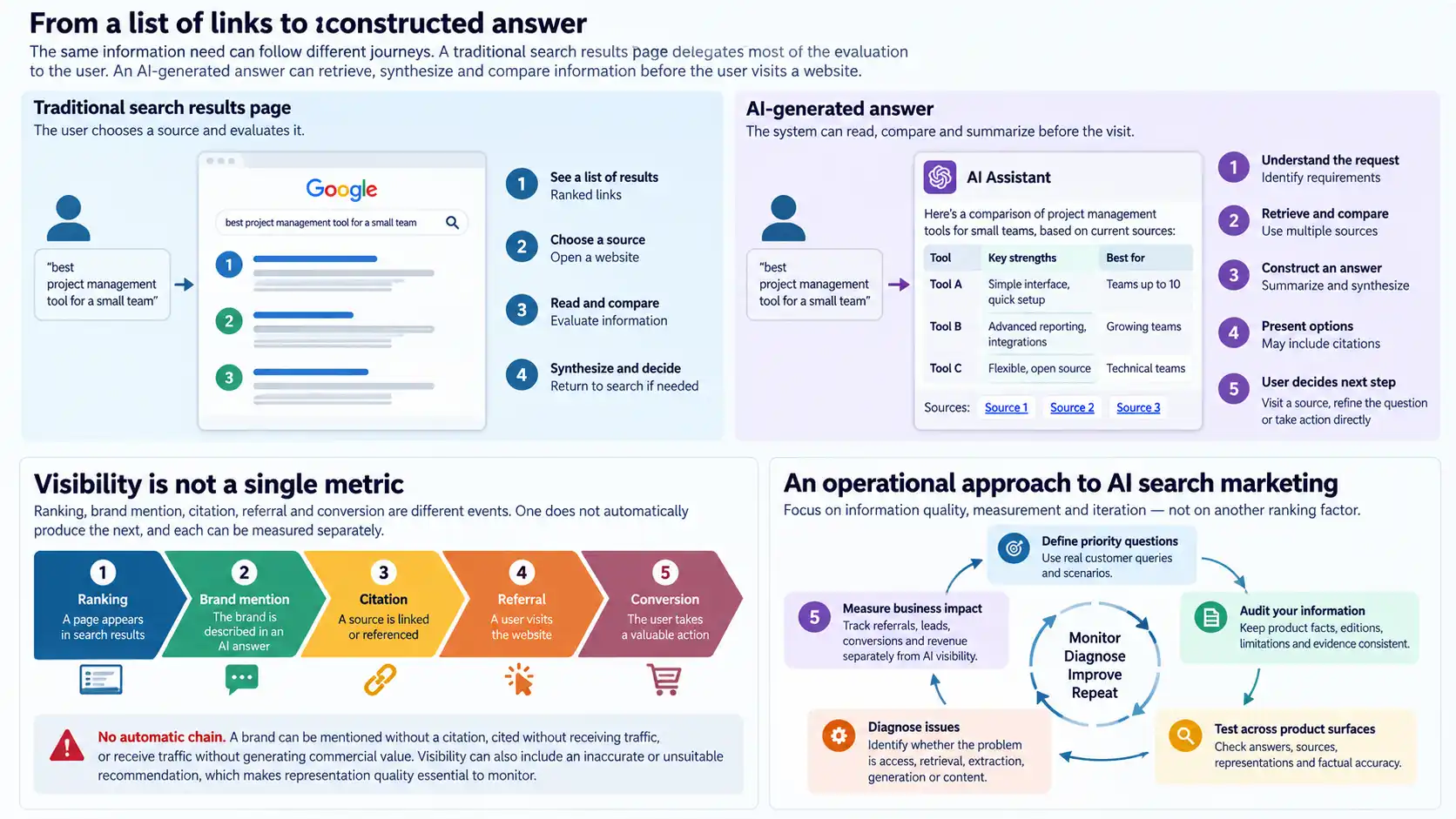
That turns an unbounded “AI SEO” project into a manageable information-quality and search-marketing program.
The next step is understanding the model and system mechanics. For the complete explanation and operating framework, the reference edition is AI-Optimized Marketing: Understanding and Influencing LLMs, 1.5.0-LEGACY. This article introduces the change in the search journey; the research provides the deeper mechanisms, worked examples and source trail.
Enjoy Ad Free
Access the full Research Paper. For free.
This article is just an extract from the full 100 pages independent research I’ve written for Fuel LAB® Research over 4 years of analysis, studying LLMs models, and data collection.
FAQs
How do AI and LLM-based answers change search marketing?
They can move part of source comparison, interpretation and product evaluation into the generated answer before a user visits a publisher. That changes where brands can be represented and evaluated, but it does not make search rankings, websites or downstream actions irrelevant. Measure inclusion, representation, attribution, visits and commercial outcomes separately.
Do AI summaries necessarily reduce website traffic?
No universal outcome follows from the presence of an AI summary. Some informational needs may be satisfied without a visit, while complex research, original evidence, documentation or purchase journeys can still create a reason to click. Aggregate observational studies describe their own samples and periods and should not be treated as automatic forecasts for an individual website.
Is ranking in Google enough to appear in an AI answer?
No. Search ranking can contribute when Google Search is part of the information path, but query reformulation, retrieval, reranking, passage selection and context assembly can produce a different source set. Other AI workflows may also use uploaded documents or different information collections. Search position and final AI citation are separate observations.
What is query fan-out in AI search?
Query fan-out is a way of pursuing a complex information need through multiple related searches, subtopics or data sources. Google described this behavior for AI Mode in May 2025. It does not imply that every LLM always issues the same number of queries, uses a fixed query length or preserves every requirement automatically.
How should marketers measure AI visibility?
Use a defined prompt panel and record the product surface, date, available sources, brand and competitor mentions, citations and factual errors. Keep those sampled observations separate from referrals, qualified leads, conversions and revenue. The full 1.5.0-LEGACY research develops the measurement framework and explains why one visibility score cannot represent total market exposure or commercial impact.
The wider outlook on agentic systems is a separate research task. This page stays with the legacy question: how generated answers and their information paths change discovery, representation and the evidence a marketing team needs.

Pietro Mingotti is an Italian neural science researcher, entrepreneur and technical marketing specialist, best known as the founder and owner of Fuel LAB®, a leading digital marketing and technical marketing agency based in Italy, operating worldwide. With a passion for science, creativity, innovation, and technology, Pietro has established himself as a thought leader in the field of technical marketing and data science and has helped numerous companies achieve their goals.