
Last updated on September 20th, 2026 at 02:33 pm
TL;DR
- Fluency, factual correctness and faithful use of evidence are different properties. A polished answer can still confuse a product, version, date or supporting source.
- “Hallucination” describes an output problem, not necessarily its cause. The failure may originate in learned associations, missing evidence, retrieval, extraction, generation or attribution.
- Generalization and memorization can coexist. Language models can learn patterns that apply beyond individual examples while also reproducing some training sequences verbatim.
- Retrieval improves access to evidence, not guaranteed correctness. The wrong source can be retrieved, a qualification can disappear, or the model can misuse evidence it actually received.
- A citation is not proof of support. Verify that the cited passage actually establishes the specific claim, including product, version, conditions and time period.
- Confidence must be evaluated. Assertive language and high next-token probability are not calibrated probabilities that a proposition is true.
- For brands, maintain a reference set of consequential facts. A corrected source, a corrected external answer and a commercial result are three different outcomes and should be measured separately.
Large language models create an uncomfortable combination: they can answer difficult questions remarkably well and still make elementary factual mistakes.
The easy explanation is to say that LLMs “do not really know anything”. But that statement is too blunt to be useful. If a system correctly compares two products, follows a technical specification or solves a problem, dismissing the result as mere token prediction does not explain what worked. Conversely, a fluent answer does not become reliable simply because the model is capable.
A better approach is operational.
What information was available? What claim did the system produce? What evidence supports it? And where could the information path have failed?
A polished answer is not proof of correctness. But the fact that language is generated token by token is not proof that the system cannot solve a problem either.
Test the behavior, preserve the evidence and describe the result at the right level.
This distinction matters directly in marketing. A brand mention can look like successful “AI visibility” while assigning a competitor’s feature to your product. A citation can point to your website while supporting only half of the sentence attached to it. Exposure without representation quality can therefore conceal the most consequential error.
Research context: adapted from AI-Optimized Marketing: Understanding and Influencing LLMs, edition 1.5.0-LEGACY — Frozen Outlook. The underlying research concerns the 2023–2025 transition toward generated answers; its evidence review and master revision are dated 17 September 2026.
How to read this in 2026: modern AI products may combine language models with web search, retrieval, uploaded files, external memory, tools and additional reasoning or validation steps. Those capabilities can provide better evidence and reduce particular errors. They do not collapse factuality into a solved problem.
The durable question is still whether the final claim is correct and whether the evidence actually supports it. Current research on uncertainty calibration likewise continues to find that assertive language is not a dependable substitute for measured confidence.


Enjoy Ad Free
Access the full Research Paper. For free.
This article is just an extract from the full 100 pages independent research I’ve written for Fuel LAB® Research over 4 years of analysis, studying LLMs models, and data collection.
LLM Hallucinations: Diagnose the Failure, Not Just the Symptom
“Hallucination” is useful shorthand for an AI answer that contains fabricated, unsupported or incorrect material. It becomes less useful when we treat the word as an explanation.
An incorrect answer can arise for several very different reasons.
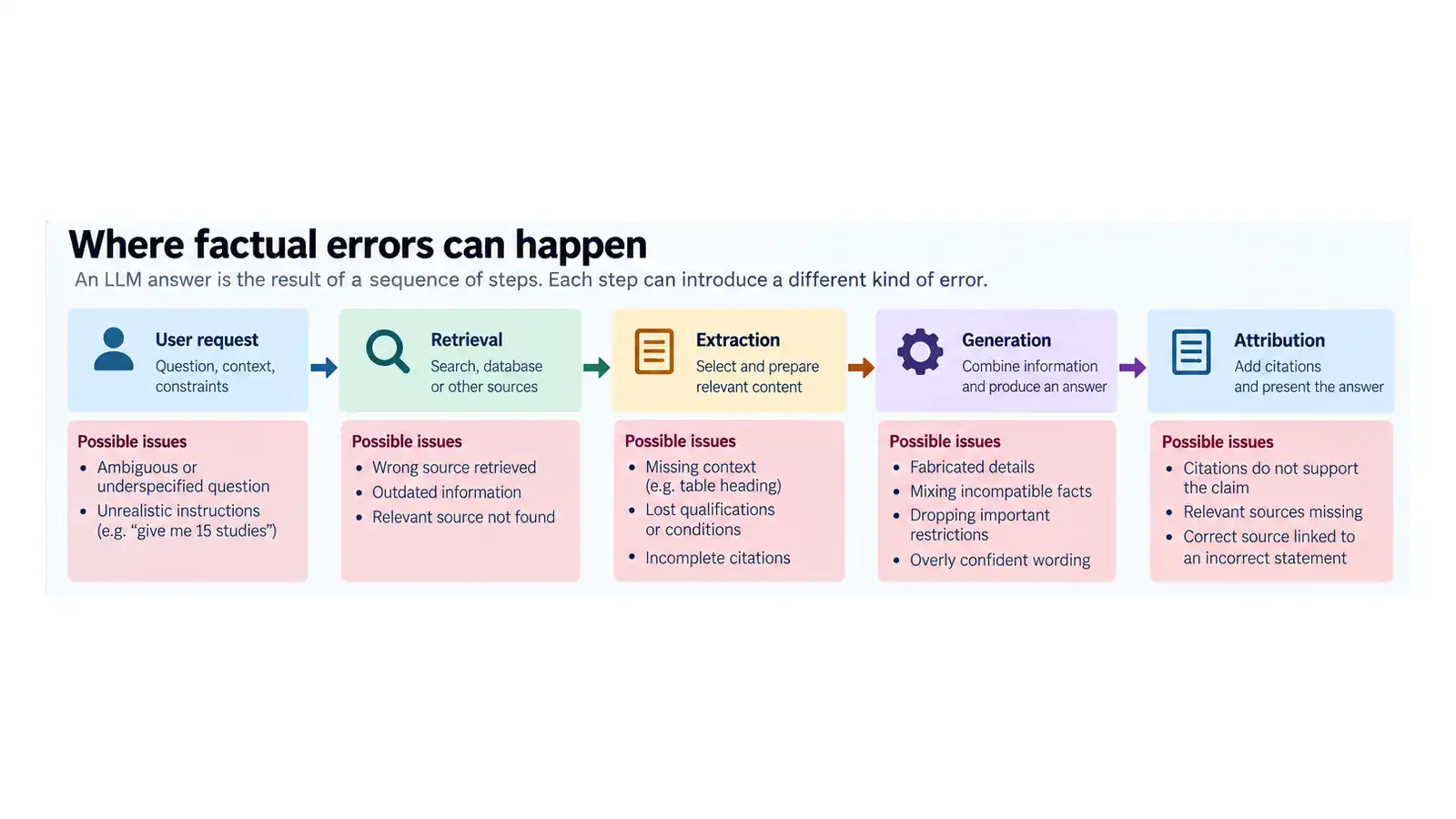
The model may generate an unsupported completion from its learned parameters. A retrieval system may supply the wrong document. The right document may be found but the relevant table heading may disappear during extraction. A correct passage may enter the context and then lose a restriction during generation. Or the final answer may be accurate while the displayed citation points somewhere else.
Those are not the same failure.
It is also useful to distinguish factual correctness from faithfulness. In a document-grounded task, faithfulness asks whether the response preserves what the supplied source says. Factual correctness asks whether the resulting claim is actually true for the question being answered.
The two can diverge.
Imagine a fictional version 2 manual stating that an export feature is available. If an assistant says the feature is unavailable, it is unfaithful to the supplied manual. But if the user is actually asking about version 3, accurately repeating the old manual could still produce a factually wrong current answer.
This produces several recurring error patterns:
- Fabricated evidence: a quotation, statistic, source or study cannot be found in the cited or supplied material.
- Temporal confusion: information about one release or period is presented as though it applies to another.
- Entity confusion: a feature is assigned to the wrong company, product, edition or add-on.
- Context loss: a valid value survives while the unit, restriction or condition that makes it correct disappears.
- Broken attribution: a real source is linked to a sentence containing claims that the source does not actually support.
The next-token training objective helps explain how plausible text can be generated without an explicit reference. But next-token prediction does not make factual error inevitable, and it does not identify the cause of a particular failure.
Next-token prediction is a computational objective. Factual support is an evaluation requirement.
A system can be excellent at the first and still require separate mechanisms and tests for the second.
When an answer looks wrong, follow the information path instead of stopping at the label “hallucination”:
- Was adequate evidence available? If not, the model may answer from learned associations or generate a familiar-looking completion instead of abstaining.
- Was the right source retrieved? An obsolete manual or similarly named product can lead the entire answer in the wrong direction.
- Did extraction preserve the important context? A table value without its row heading or a feature without its edition can become misleading.
- Did generation preserve the evidence? The correct source can be present while the answer merges two incompatible claims.
- Does the citation support what it appears to support? Attribution needs its own inspection.
The prompt can also create pressure toward unsupported completion. “Give me fifteen studies proving this claim” is not a good research instruction if fifteen relevant studies do not exist. A reliable system should investigate the evidence—including contrary or insufficient evidence—rather than satisfy an arbitrary requested count.
An incorrect answer does not establish a human-like intention to deceive. That distinction matters conceptually, but it does not reduce the practical consequence of the error.
For a business, the useful question is what failed, what can be corrected, and which control could detect the same failure next time.
Retrieval can materially improve this information path by supplying external evidence that is not reliably available from parameters alone. The foundational Retrieval-Augmented Generation work by Lewis and colleagues explicitly combines parametric generation with non-parametric retrieval.
But “RAG enabled” is still not a diagnosis. Collection, retrieval, reranking, context assembly, generation and attribution remain separate places where an answer can improve—or fail.
Compression, Generalization and Memorization Can Coexist
Two opposite metaphors frequently cause confusion.
The first imagines an LLM as a giant searchable copy of the internet. The second argues that because the model compresses information into parameters, it cannot memorize specific text.
Neither description is adequate.
Language models can generalize: they learn statistical regularities that support useful behavior on combinations and examples not reproduced verbatim from training.
They can also memorize particular sequences.
Carlini and colleagues’ training-data extraction research demonstrated that verbatim sequences from GPT-2 training data could be recovered from the model. Some extracted examples had appeared only once in the training corpus.
That result is important because it rejects the universal claim that parameterized language models cannot memorize. It does not establish that every generated fact was memorized, that every piece of training data is recoverable, or that a model can provide reliable provenance for its output.
- Generalization: learned regularities support behavior beyond individually stored examples.
- Memorization: some specific sequences can be reproduced under suitable conditions.
- Provenance: neither process gives the user a dependable map from a generated claim back to the training document that caused it.
The compression metaphor is useful only within limits.
Repeated information may influence learned behavior, but frequency does not guarantee correct recall.
Rare information may be harder to reproduce reliably, but “rare” does not mean “necessarily discarded”.
A memorized phrase can lose its original context, and a generated attribution can still be wrong.
Consider a familiar fact such as a capital city. A model may answer correctly from its parameters without retrieving a webpage at runtime. That does not establish which training document supplied the association.
If we then ask “Where did you learn that?”, the answer is itself another generation. Unless the system has explicit provenance machinery, it should not be treated as an audit of the training corpus.
The operational distinction is therefore between parametric behavior and external evidence supplied at runtime. Modern products can combine both, and can also store information in external memory or knowledge systems without changing the foundation model’s parameters.
For a publisher, this creates two distinct problems. Information about the brand may be reproduced without transparent provenance, and it may be reproduced incorrectly. Repeating the same marketing phrase across many websites is not a controlled intervention into another provider’s training process.
Accuracy and Coverage: Measure Both
“How accurate is the model?” sounds like a simple question until we ask what happens when the model chooses not to answer.
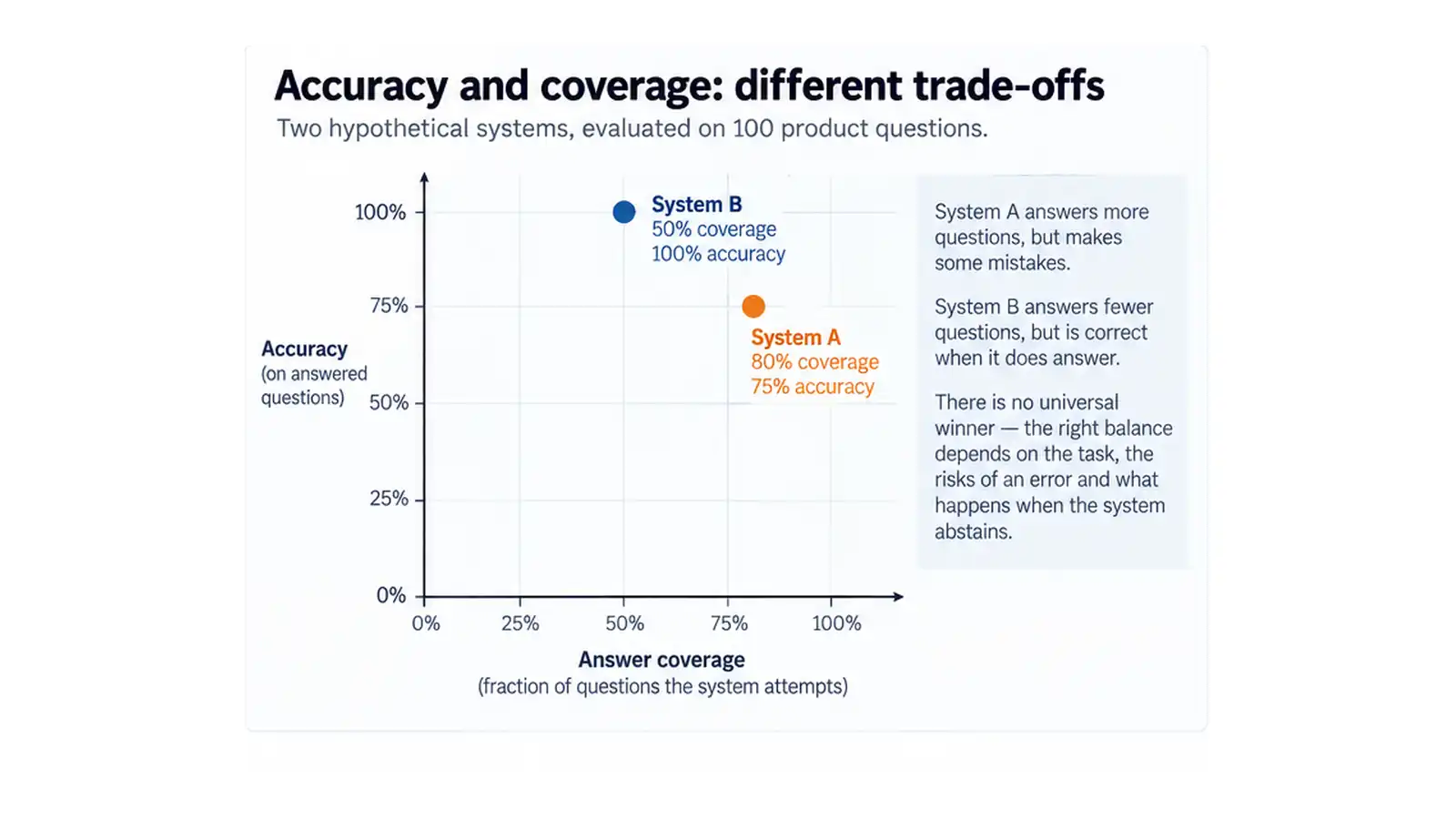
Suppose we evaluate two systems on 100 invented product questions.
System A answers 80. Sixty are correct and twenty are wrong; it abstains on the remaining twenty.
System B answers only 50, but all fifty are correct; it abstains on the other fifty.
The first has 80% answer coverage and 75% accuracy among answered questions. The second has 50% coverage and 100% accuracy among answered questions.
There is no universal winner.
If an incorrect answer can create regulatory or financial harm, abstaining may be preferable. If unanswered questions can easily be routed to a person, lower coverage can be acceptable. In a low-risk exploratory workflow, broader coverage may have greater utility.
The task defines the trade-off.
For brand and product information, aggregate accuracy is also not enough. Different errors have different consequences:
- Wrong specification: a capability is invented or assigned to the wrong product edition.
- Wrong time frame: an obsolete offer, price or support condition is represented as current.
- Wrong entity: information about another company or similarly named product is merged into the answer.
- Wrong transformation: valid values are combined incorrectly, units disappear or a table cell becomes detached from its heading.
- Unsupported attribution: the response provides a real citation that does not support the proposition attached to it.
Consider a fictional service called Northline. Its standard plan retains data for 30 days; an enterprise add-on extends that to 90 days.
An AI answer can fail by saying “Northline retains data for 90 days” without the edition restriction. It can confuse Northline with another company. It can even link both correct source documents while still producing the unsupported conclusion “90 days for every customer”.
Check relationships, not matching words. Seeing “90 days” in a retrieved passage is not enough. The answer must preserve the entity, product, edition, condition and relevant period. A valid hyperlink does not repair a statement that combines incompatible facts.
For a system you operate, record wrong answers, abstentions and routed cases as well as successes. For an external answer engine, preserve the prompt, output, date, product surface and visible sources before drawing conclusions.
Why Confident Language Can Mislead
Language models are extremely good at producing the linguistic form of certainty.
Unfortunately, the linguistic form of certainty and calibrated factual confidence are not the same thing.
“Paris is the capital of France” should not normally need a paragraph of hedging. A well-supported fact can and should be stated clearly. But the same decisive syntax can also appear in an incorrect product comparison or invented historical claim.
Calibration asks whether reported or inferred confidence corresponds to actual correctness across a defined collection of cases.
If a system labels 100 comparable answers as “90% confident”, a well-calibrated system should be correct on roughly ninety of them. One confident paragraph tells us nothing about that relationship.
Recent research continues to treat faithful uncertainty communication as an open problem. The relevant point for this article is not that models can never express uncertainty—they can—but that assertive wording should not be treated as an independently validated confidence measure.
“Available only in the enterprise edition” is part of the fact.
Removing the qualification because the shorter sentence sounds more confident does not improve the answer. It changes its meaning.
Token probabilities create another common confusion.
A token can be highly probable because it is a natural continuation of the preceding text. That does not make the complete proposition true. A model can confidently reproduce a common misconception or continue a false premise supplied by the user. Conversely, a correct but unusual proper name may require individually low-probability tokens.
Probability over wording and probability that a proposition is factually correct are different objects.
Citations add one more layer of apparent confidence. A source list can make an answer look researched while concealing weak support.
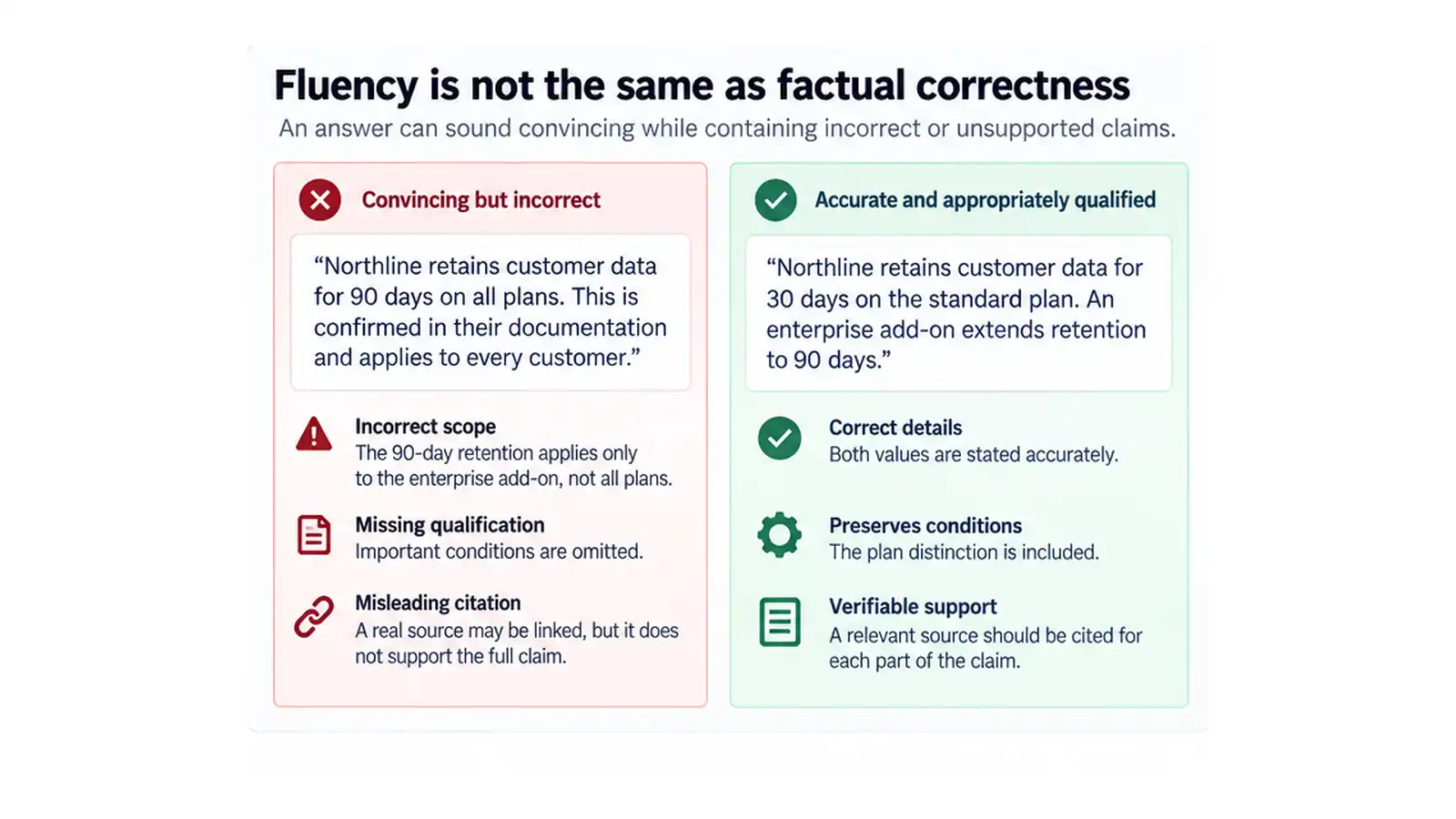
Gao and colleagues’ ALCE research usefully separates answer quality from citation correctness and completeness. That distinction extends beyond the benchmark: inspect what each reference actually establishes.
A citation is useful because it makes a claim inspectable.
Ask whether it resolves to the intended source, whether the relevant passage supports the proposition, whether an important qualification is missing, and whether consequential uncited claims remain.
Fact Hygiene for Brands and Products
For marketing teams, the practical answer is not to eliminate every possible hallucination on the internet. That objective is neither controllable nor measurable.
A more useful program begins by defining the facts that would be consequential if represented incorrectly.
Maintain a reference set containing, where relevant:
- the canonical company and product name;
- edition, plan or version;
- the feature or specification;
- important limitations or eligibility conditions;
- the period for which the claim is valid;
- the maintained source that supports it.
This does not force an external assistant to use your preferred source. It gives you a defensible reference against which its representation can be evaluated.
That makes several otherwise vague complaints measurable. Did the answer:
- change the scope of a supported statement?
- assign one product’s capability to another?
- cite a valid page but summarize it incorrectly?
- use an obsolete external description instead of the currently applicable version?
A practical review can follow four steps:
Record the prompt, product surface, date, answer and visible sources.
Compare each consequential claim with the maintained fact record and its conditions.
Diagnose whether the failure concerns source content, retrieval, extraction, generation or attribution.
Correct and retest what you control without reporting the source edit itself as evidence that the external system changed.
Then keep the outcome layers separate.
Updating an inaccurate product page is one result. Observing that an external AI answer subsequently changed is another. Demonstrating that the change affected visits, qualified leads or revenue is a third.
Collapsing those events into one “AI optimization success” destroys the evidence needed to understand what actually worked.
Enjoy Ad Free
Access the full Research Paper. For free.
This article is just an extract from the full 100 pages independent research I’ve written for Fuel LAB® Research over 4 years of analysis, studying LLMs models, and data collection.
Summary
| Failure or risk | What to investigate rather than assume |
|---|---|
| Unsupported or fabricated answer | Availability of adequate evidence, source selection, context, generation and whether clarification or abstention was allowed. “Next-token prediction” alone is not a complete diagnosis. |
| Unreliable recall or provenance | Learned associations, context and the tested task. Generalization and memorization can coexist; neither provides a reliable bibliography for every output. |
| Incorrect or incomplete citation | Source identity and version, whether the passage supports the full claim, and whether consequential claims remain unsupported. A real URL is not sufficient. |
| Overconfidence | Correctness across a defined set of cases, alongside expressed confidence and answer coverage. Decisive wording and token probability are not truth scores. |
| Wrong brand, product or edition | Entity identifiers, source versions, limitations, extraction quality and conflicting evidence. Check relationships, not only matching names or numbers. |
| Degradation under recursive synthetic-data training | The recursion, sampling, source-data preservation, verification and selection conditions. Such research does not prove that all AI-assisted publishing is unusable. |
Factuality is not guaranteed by fluent prose, model scale, retrieval or citations. Generalization and memorization can coexist. External evidence can be unavailable, selected incorrectly or misused after retrieval. Confident language can exceed the evidence supporting it.
The right response is therefore not to ask whether LLMs “really know things” in the abstract. For a practical task, ask whether the system produced the correct claim, whether the relevant evidence was available, whether that evidence supports the claim and whether the system communicates uncertainty appropriately.
The text diagram below preserves another important distinction: training and runtime are different processes. It is a conceptual map, not executable code and not a description of one proprietary system.
TRAINING AND ADAPTATION

[Data and objective]
        ↓
[Tokenized training examples]
        ↓
[Parameter optimization]
        ↓
[Trained checkpoint]
        ↓
[Applicable post-training / adaptation]
        ↓
[Evaluated model configuration]


APPLICATION RUNTIME

[Authorized request and permitted context]
        ↓
[Optional retrieval / tools / external memory]
        ↓
[Context supplied to the model]
        ↓
[Model computation and generation]
        ↓
[Further context or tool result, when needed]
        ↓
[Validation / attribution / user-facing output]
The full 1.5.0-LEGACY research develops these distinctions through source analysis, worked examples and the broader measurement framework. The next practical question is how source passages reach a generated answer.
FAQs
Do LLMs really know things?
The useful operational question is whether the system can produce a correct and appropriately supported answer for the task. Learned representations support real capabilities, while individual answers can still be wrong. Neither fluent language nor the fact that generation uses next-token prediction is enough to determine reliability or settle philosophical questions about human-like understanding.
Why do language models hallucinate?
“Hallucination” describes an incorrect, fabricated or unsupported output but does not identify its cause. Failures can originate in learned associations, missing evidence, stale or incorrect retrieval, lost context, generation or attribution. Diagnose the source-to-answer path rather than treating hallucination as one mechanism.
Do LLMs memorize text, or only compress patterns?
Both generalization and memorization can occur. Research has demonstrated extraction of verbatim GPT-2 training examples, which rejects the claim that memorization is impossible. That does not make a language model a searchable archive or provide reliable provenance for every generated claim.
Does retrieval or a citation guarantee factual accuracy?
No. Retrieval can supply useful evidence while still selecting an obsolete or irrelevant source. Extraction can remove qualifications, generation can combine incompatible facts, and a citation can point to a real source that does not support the complete claim. Each stage requires separate evaluation.
How should marketers handle AI misrepresentations?
Maintain a reference set of consequential brand and product facts, including versions and limitations. Preserve the prompt, product surface, date, answer and visible sources when an error appears. Diagnose the failed stage, correct what you control and retest. A source correction, an external answer change and a business effect are separate outcomes.
Can confident wording tell me whether an AI answer is correct?
No. Linguistic confidence is not a calibrated probability of factual correctness. Calibration has to be evaluated across a defined set of comparable cases. Token probabilities also concern the likelihood of possible continuations, not directly the truth probability of the complete proposition.

Pietro Mingotti is an Italian neural science researcher, entrepreneur and technical marketing specialist, best known as the founder and owner of Fuel LAB®, a leading digital marketing and technical marketing agency based in Italy, operating worldwide. With a passion for science, creativity, innovation, and technology, Pietro has established himself as a thought leader in the field of technical marketing and data science and has helped numerous companies achieve their goals.