
Last updated on September 20th, 2026 at 02:12 pm
TL;DR
- Post-training shapes model behavior after pre-training. Demonstrations, preference data, rewards, graders and application controls play different roles; the final answer does not reveal which combination produced it.
- The classic RLHF pipeline remains a useful reference. In InstructGPT, supervised fine-tuning was followed by human preference comparisons, reward-model training and PPO-based policy optimization.
- RLAIF changes where part of the feedback comes from. Constitutional AI documented AI-generated critique and preference data in 2022 while retaining human choices about principles, objectives and evaluation.
- DPO and KTO change the optimization or feedback format. DPO learns directly from preference pairs relative to a reference policy; KTO can work with desirable and undesirable examples without requiring paired responses to the same prompt.
- A preference or reward score is not a truth score. Optimizing the chosen objective can improve desired behavior while leaving factual errors, source mismatches or uncovered edge cases.
- Alignment is not a website-ranking mechanism. A model being trained to produce helpful answers does not imply that “neutral” pages receive a citation boost or that sales copy is automatically suppressed.
- Read these methods as reference architectures, not a 2026 product recipe. Current systems can combine supervised training, preference optimization, reinforcement learning, synthetic feedback, graders and application-level controls in ways providers do not fully disclose.
Pre-training gives a language model a broad ability to continue text, represent patterns and perform many tasks. But that alone does not make it behave like the assistant a user expects.
A user usually wants something more specific: follow the instruction, respect the requested format, preserve important conditions, avoid unsupported claims and communicate uncertainty when the evidence is incomplete.
This gap between being able to generate language and behaving according to selected objectives is where post-training becomes important.
It is also where terminology becomes confusing. RLHF, RLAIF, DPO and KTO are often presented as successive generations of one method, as though the newest acronym simply replaced the previous one. That is not a useful model of what happened.
They change different parts of the process: where training examples come from, how preferences are represented, whether a separate reward model is learned, and how the policy parameters are optimized.
The InstructGPT paper by Ouyang and colleagues (2022) gives us a particularly useful reference architecture: supervised demonstrations, human comparisons used to train a reward model, and reinforcement learning to optimize the language model under that learned reward.
Research context: adapted from AI-Optimized Marketing: Understanding and Influencing LLMs, edition 1.5.0-LEGACY — Frozen Outlook. The research addresses the 2023–2025 period; its evidence review and editorial revision are dated 17 September 2026. This article was checked again for present-day context on 20 September 2026.
How to read this today: RLHF, RLAIF, DPO and KTO remain useful reference methods, but they do not constitute a complete map of current post-training. OpenAI currently documents supervised, preference-based and reinforcement fine-tuning as distinct methods, including reinforcement fine-tuning for reasoning models; Anthropic published a new Claude Constitution in January 2026 and continues to describe constitutional principles as part of its model-training process. Exact frontier-model recipes remain provider-specific and often undisclosed.
Current references: OpenAI Reinforcement Fine-Tuning documentation and Anthropic’s 2026 Claude Constitution update.
For marketers, the control boundary is straightforward. A company training or customizing its own model may be able to design examples, preference data, graders or validation rules. A publisher writing a public webpage usually does not control the post-training objective of an external provider.
Post-training can change how an assistant answers. It does not, by itself, tell us which websites the surrounding product retrieves, ranks or cites. Model behavior and source selection must be investigated separately.


Enjoy Ad Free
Access the full Research Paper. For free.
This article is just an extract from the full 100 pages independent research I’ve written for Fuel LAB® Research over 4 years of analysis, studying LLMs models, and data collection.
Why Pre-Training Is Not the Whole Assistant
A base language-model objective asks the model to become better at predicting sequences. It does not, on its own, define every behavior we want from an assistant.
It does not automatically say: follow the user’s instruction rather than merely continue it; cite a source when evidence is required; ask a clarifying question instead of inventing a missing identifier; or respect a particular safety boundary.
Those behaviors can be shaped through training data, post-training objectives, system instructions, retrieval design, validation and other application controls.
This means that a bad answer can fail in several different ways:
- Instruction mismatch: the response continues the subject but does not perform the requested task.
- Unsupported content: the answer confidently introduces a specification, citation or explanation not established by the available evidence.
- Unsuitable behavior: the output violates a chosen safety boundary or fails the intended use case.
- Poor communication: the answer hides the result, drops essential context or presents uncertainty as confidence.
Post-training is the broad category of training and adaptation that happens after initial pre-training. Alignment is broader and more normative: it describes attempts to make model behavior accord with selected goals, preferences, rules or values.
Neither term identifies one algorithm.
Whenever possible, name the actual mechanism. Was the model trained on demonstrations? Did annotators compare responses? Was a reward model learned? Were preferences optimized directly? Was reinforcement learning used? Or did the product simply apply a system instruction or validation step without changing the model parameters at all?
Those interventions can work together, but they are not interchangeable.
The Reference RLHF Pipeline
RLHF stands for Reinforcement Learning with Human Feedback.
The InstructGPT paper remains one of the clearest reference implementations because it separates three stages with three different jobs:
- Teach the model a supervised baseline from demonstrations.
- Learn a numerical preference signal from human comparisons.
- Optimize the language-model policy against that learned reward.
Later methods modify or replace parts of this pipeline. That does not make the conceptual distinctions obsolete.
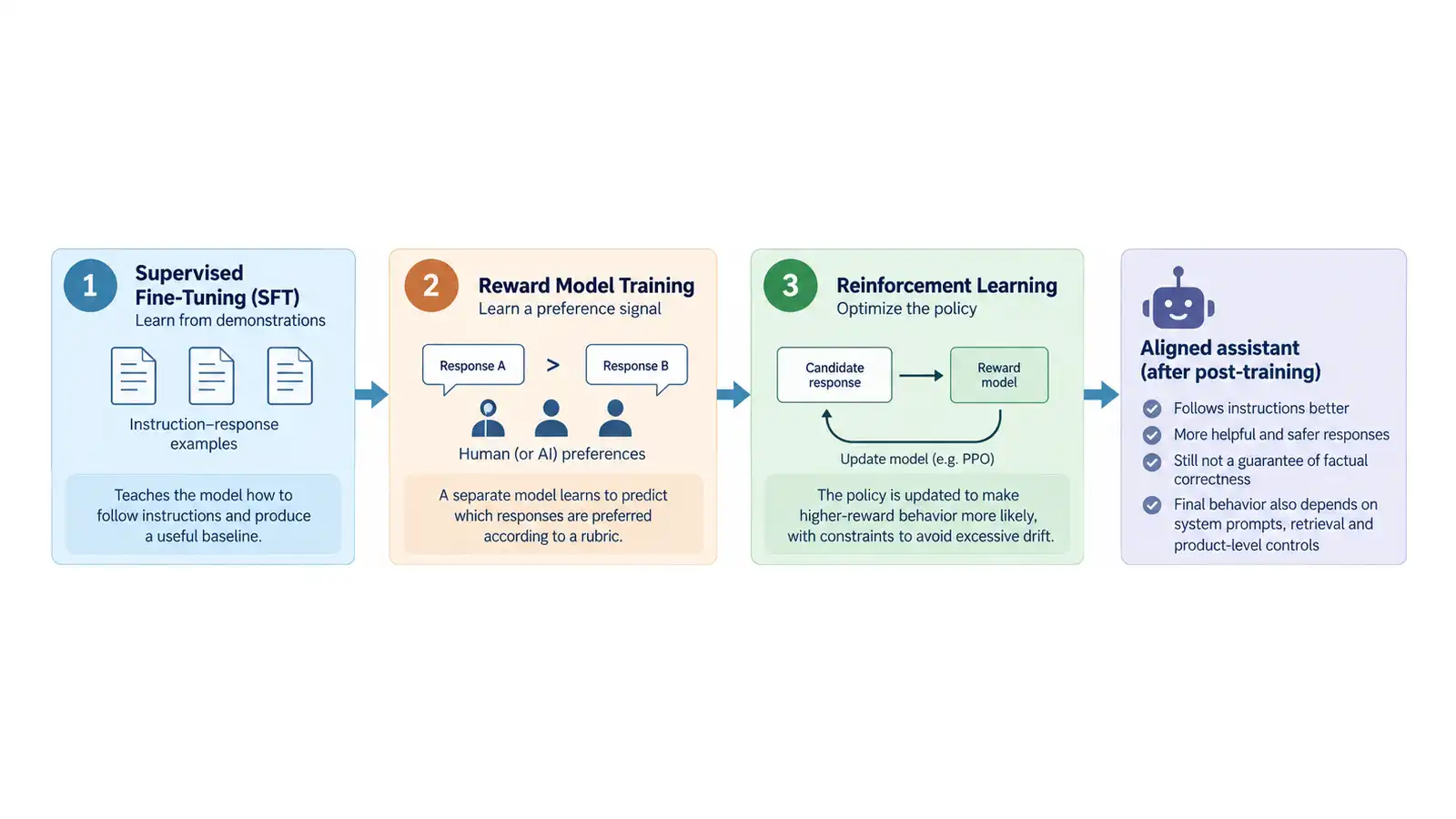
1. Supervised Fine-Tuning: Learn from Demonstrations
In supervised fine-tuning, or SFT, the model is trained on examples of the behavior we want it to reproduce.
A training example can pair an instruction with a high-quality response. The model is then optimized so that responses resembling those demonstrations become more likely under similar conditions.
This is different from putting an example into an ordinary chat. In SFT, the training process updates model parameters.
- Demonstrate the task. Show how to answer a product question while retaining its relevant edition and limitations.
- Demonstrate the boundary. Show when missing information requires a clarification instead of a confident guess.
- Demonstrate evidence use. Show how an answer should rely on supplied documentation rather than inventing a reference.
These examples illustrate dataset design; they are not claims about a provider’s private training set.
The limitations are equally important. Demonstrations cover only part of the space of possible requests. Poor or inconsistent examples can teach unwanted behavior, and success on a familiar pattern does not guarantee correct generalization to every new combination of constraints.
2. Reward Models: Learn a Preference Signal
The next step in the reference RLHF pipeline is different. Instead of writing one ideal answer, evaluators compare multiple responses to the same prompt.
Their preferences become training data for a separate reward model, which learns to predict which outputs are more likely to satisfy the evaluation rubric.
The word reward can be misleading. The score is not an objective measure of truth. It is a learned proxy for the judgments represented in the feedback data.
A rubric can include accuracy, usefulness, clarity, safety or other criteria. Evaluators can disagree. They can also prefer a convincing response that contains a subtle factual error.
Invented teaching example:
Prompt: “Explain blockchain to a six-year-old.”
A uses an age-appropriate notebook analogy without pretending the analogy is exact. B calls blockchain a magic notebook that can never be wrong. C gives an accurate but highly technical definition.
Under a rubric prioritizing age-appropriate explanation without false absolutes, an evaluator might rank A above C and B. Another audience or rubric could justify a different ranking.
The data records a preference under a defined evaluation setup. It does not establish one universally best answer.
3. Reinforcement Learning: Optimize the Policy
A language model can be treated as a policy: given a prompt and the tokens generated so far, it assigns probabilities to possible next actions—in this case, tokens.
The learned reward model can then score generated responses, and reinforcement learning updates the policy to make higher-reward behavior more likely.
In InstructGPT, the optimization method was PPO — Proximal Policy Optimization, introduced by Schulman and colleagues in 2017.
The distinction matters: human feedback describes where the preference signal originated; PPO describes one method used to optimize the policy under that signal.
The intuitive idea is simple: training changes which outputs become more likely.
The old dog-training analogy works only at that abstract level. The model does not experience reward. And improving a numerical proxy does not guarantee that every property we care about improves with it.
Reward is not factual confidence. In a common pairwise formulation, P(A preferred to B) = sigmoid(r(A) − r(B)). With invented reward scores of 1.2 and −0.2, the modeled preference probability is approximately 0.802. That is not an 80.2% probability that A is factually true. It describes the model’s predicted preference under the learned reward function.
PPO also includes mechanisms intended to keep updates from moving too aggressively away from the policy used to collect the data. In RLHF implementations, additional reference-policy penalties can further discourage excessive drift.
These controls help stabilize optimization. They do not convert the reward signal into ground truth.
A useful analogy comes from marketing measurement. If a sales team optimizes only for raw lead volume, it can improve the reported KPI while reducing lead quality. Similarly, an assistant can become better at satisfying a proxy while still failing part of the real task.
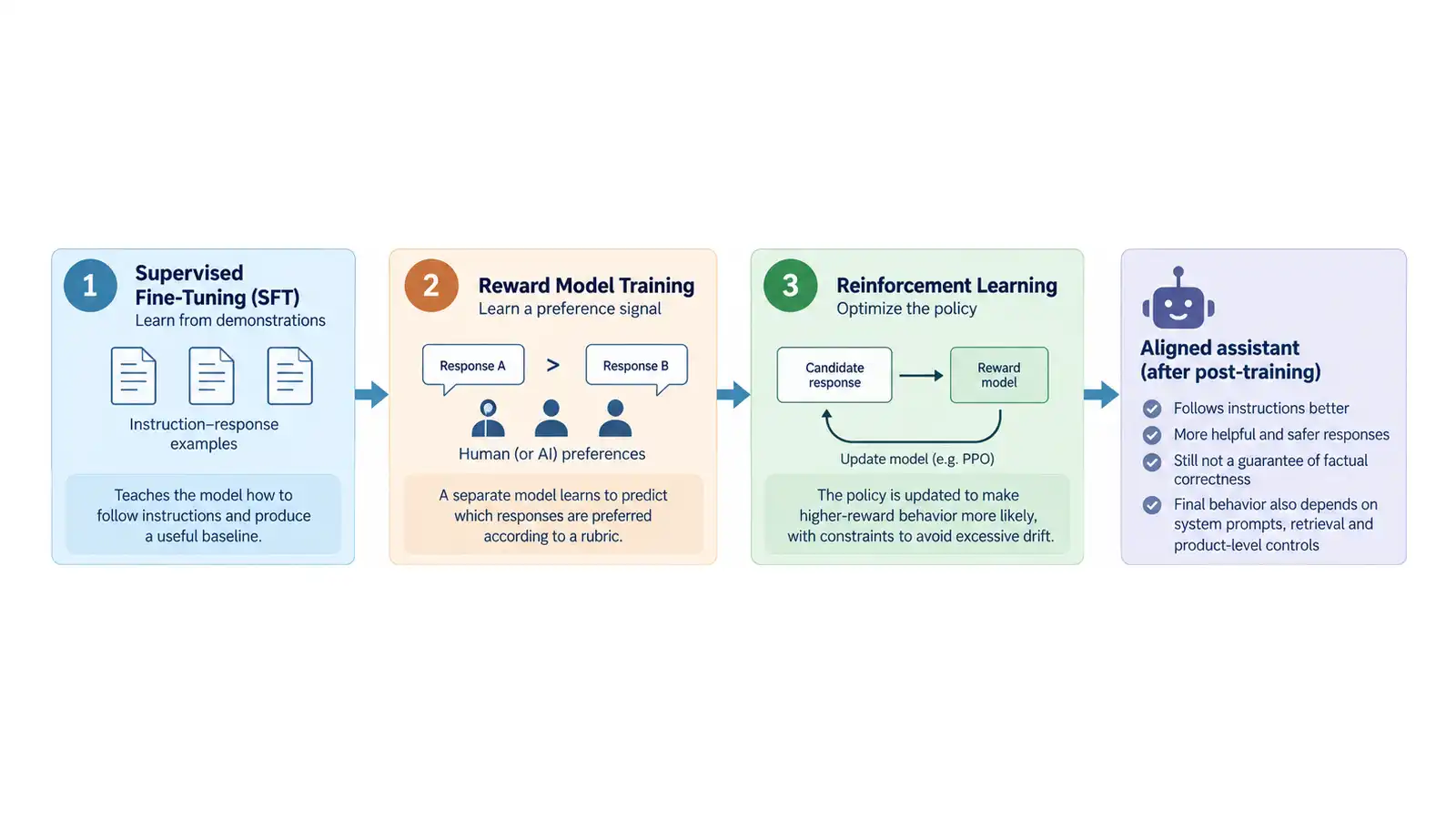
RLAIF, DPO and KTO: Different Ways to Change Post-Training
RLAIF, DPO and KTO are easier to understand once we stop treating them as generations of one product.
They address different parts of the post-training problem:
- Where feedback comes from: humans, AI systems, formal graders or combinations of them.
- How feedback is represented: demonstrations, preference pairs, scalar rewards, desirable/undesirable examples or other evaluation signals.
- How the policy is updated: supervised optimization, direct preference objectives, reinforcement learning or other procedures.
The operational question is therefore not “Which acronym is newest?” It is “What data and evaluation signal do we have, what behavior are we trying to change, and how will we know whether it improved?”
This remains relevant today. Current OpenAI documentation, for example, distinguishes supervised, DPO-based and reinforcement fine-tuning rather than describing one as the universal successor of another.
A. RLAIF: Feedback Generated with AI
RLAIF — Reinforcement Learning from AI Feedback — replaces or supplements some human judgments with judgments generated by another model or AI-based evaluator.
A foundational example is Bai and colleagues’ Constitutional AI paper, published in 2022. The work used written principles to guide critique and revision, then generated AI preference data for a reinforcement-learning stage.
That does not mean humans disappear from the process.
People still determine objectives, principles, prompts, evaluation methods and the broader deployment constraints. AI feedback changes who or what generates some labels; it does not create an independent source of truth.
- Potential benefit: automated judgments can scale feedback generation beyond repeated manual comparison.
- Potential failure: the evaluator can share biases or blind spots with the model being trained, or reward convincing style over factual correctness.
- Important boundary: generating feedback, training a checkpoint, evaluating it and releasing it are separate events.
Constitutional AI is a documented research example, not a disclosure of the complete training pipeline behind every Claude release—or any other provider’s model.
That distinction is especially relevant in 2026: Anthropic has since published a substantially expanded Claude Constitution, confirming that constitutional objectives remain part of its training framework while also demonstrating that the implementation itself evolves.
B. DPO and KTO: Preference Objectives and Data Formats
Direct Preference Optimization (DPO), introduced by Rafailov and colleagues in 2023, simplifies the conventional RLHF pipeline by optimizing preference pairs directly through the language-model policy relative to a reference policy.
Instead of first fitting an explicit reward model and then running a separate reinforcement-learning loop, DPO derives an objective that can train directly from preferred and rejected responses.
- DPO still needs preference data. The method cannot repair a wrong or badly scoped preference simply because the optimization loop is simpler.
- The reference policy still matters. The objective is based on how the preferred and rejected responses compare relative to that reference.
- Evaluation remains necessary. Better performance on the preference objective does not establish complete correctness on the intended task.
KTO means Kahneman–Tversky Optimization. The 2024 paper by Ethayarajh and colleagues proposed a utility-based preference objective inspired by prospect theory.
A practical difference is the feedback format: KTO can learn from examples labeled desirable or undesirable without requiring a preferred/rejected pair generated from the same prompt.
For example, a product assistant response that incorrectly assigns an enterprise-only feature to every subscription tier could be labeled undesirable, while a response preserving the edition restriction could be labeled desirable.
The psychological inspiration should not be anthropomorphized. The model does not need to experience human loss aversion for the mathematical objective to be useful.
What Alignment Does—and Does Not—Explain About Content Visibility
This is the point where an explanation of post-training often turns into bad marketing advice.
If assistant models are trained to produce useful, clear and safe responses, it is tempting to conclude that web pages written in a “helpful” or “neutral” style must therefore receive preferential treatment during retrieval or citation.
That inference does not follow.
Post-training changes the behavior of the model. A search or retrieval system can have its own candidate generation, ranking and filtering logic. The final product may then add citation rules or validation after generation.
Useful answer-quality criteria include:
- Clarity: does the answer identify the right subject and communicate the result intelligibly?
- Instruction-following: does it perform the requested task instead of answering a nearby question?
- Evidence discipline: are version, scope and qualifications preserved?
- Appropriate uncertainty: does the answer distinguish supported information from missing evidence?
Those are useful evaluation dimensions. They are not demonstrated website-ranking factors.
For publishers, the defensible objective is simpler: make the information accurate, useful and explicit enough to survive retrieval and interpretation. Do not remove important qualifications merely to sound more decisive, and do not rewrite legitimate commercial information into artificial encyclopedia prose because you imagine a reward model prefers it.
- Keep consequential restrictions close to the claim. “Enterprise edition only” belongs with the feature it limits.
- Separate explanation from unsupported persuasion. State the specification before claiming that it makes the product “best”.
- Test selection and use independently. A correct source can be retrieved and then misrepresented; another may contain the answer and never be selected.
A useful source-to-answer analysis needs at least three layers:
- Retrieval: which source and version became available?
- Generation: what did the model preserve, infer, omit or invent?
- Application controls: what instructions, validation steps or citation mechanisms shaped the delivered answer?
Does a Thumbs-Up Update the Model?
No: clicking thumbs up or thumbs down does not immediately rewrite the deployed model’s parameters.
Feedback is first a product event. What can happen afterward depends on the service, account type, privacy settings and provider policy.
- Feedback can be logged or reviewed. A provider may retain eligible feedback for evaluation or model-improvement processes.
- Feedback can be aggregated. Patterns across many reports can reveal recurring failures without changing the active model immediately.
- Eligible data can contribute to later training. That still occurs in a separate training or improvement process, not as an instant parameter update caused by your click.
OpenAI’s current data-use guidance makes the distinction explicit. For consumer services such as ChatGPT, content may be used for model improvement unless the user opts out. Even after opting out, a user can voluntarily submit feedback, in which case the conversation associated with that feedback may be used for training. Business products and API data are not used for training by default unless the organization explicitly opts in.
None of those policies implies that one vote updates the model you are currently talking to.
A corrected answer in the same conversation may simply reflect the correction now present in the context. A changed answer next month might come from different retrieval, system instructions, a product update or a newly deployed model. The thumbs-up alone does not identify the cause.
Evaluate the behavior you actually need. For a product comparison, correct edition, accurate limitations and supporting evidence matter separately from whether the response feels polished or helpful. A stronger “helpfulness” impression can still hide a consequential factual error.
The same logic applies to a company’s own assistant. Retrieval restrictions, validation, system prompts and human review can change application behavior without retraining the underlying model. A successful test proves that the configured system worked under those conditions—not that it permanently learned the rule.
Enjoy Ad Free
Access the full Research Paper. For free.
This article is just an extract from the full 100 pages independent research I’ve written for Fuel LAB® Research over 4 years of analysis, studying LLMs models, and data collection.
Summary
| Method / layer | Role and limitation |
|---|---|
| Supervised fine-tuning (SFT) | Learns from demonstrations of desired behavior by changing trainable parameters. It is different from supplying examples only in a prompt. |
| Reward model in the reference RLHF pipeline | Learns a preference signal from comparisons. Its score reflects the data and rubric, not a direct measurement of truth. |
| PPO in the reference RLHF pipeline | Optimizes a language-model policy using reward signals. PPO is an optimizer, not a synonym for human feedback or a guarantee of correctness. |
| RLAIF / Constitutional AI | Uses AI-generated feedback in a specified training procedure. Human choices about principles, data and evaluation remain; Constitutional AI was published in 2022. |
| Direct Preference Optimization (DPO) | Optimizes preferences through the policy relative to a reference without the conventional separate reward-model and RL loop. Preference-data quality still matters. |
| Kahneman–Tversky Optimization (KTO) | Uses desirable/undesirable feedback and a utility-inspired objective without requiring paired comparisons. It is not “Kullback–Leibler Training Objective”. |
| User feedback and product-level controls | Feedback may inform processes under the provider’s policies; a click is not evidence of an immediate weight update. Instructions, source restrictions and validation can shape runtime without training. |
| Marketing interpretation | Answer preferences do not automatically define website-ranking factors. Test source selection, faithful use, citations and business outcomes separately. |
SFT learns from demonstrations. Classical RLHF can learn a reward model from preferences and optimize a policy under that reward. RLAIF changes where some feedback comes from. DPO removes the conventional explicit reward-model-plus-RL loop for preference pairs. KTO supports a different preference-data format. Reinforcement fine-tuning and other modern procedures add further possibilities.
The common lesson is more important than the acronyms: behavior depends on the objective, data, evaluation and surrounding system. A training method should be judged by what it accomplishes on the intended task, not by whether its name is newer.
Continue with knowledge, memorization and factuality to examine what can still go wrong after post-training. The full 1.5.0-LEGACY research develops the equations, worked examples and marketing distinctions beyond this article.
FAQs
What is RLHF in a language model?
RLHF means Reinforcement Learning with Human Feedback. In the reference InstructGPT pipeline, demonstrations are used for supervised fine-tuning, human comparisons train a reward model, and reinforcement learning optimizes the language-model policy under that learned reward. It is an important reference pipeline, not the only form of modern post-training.
What is the difference between RLHF and RLAIF?
RLAIF uses AI-generated judgments for part of the feedback or reward-construction process instead of relying exclusively on human comparisons. Humans still define objectives, principles and evaluation. Constitutional AI provided an influential example in 2022, and Anthropic continues to use constitutional principles in its current training framework.
How does DPO differ from conventional RLHF?
DPO optimizes preference pairs directly through the language-model policy relative to a reference policy. It avoids the conventional sequence of fitting a separate explicit reward model and then running a separate reinforcement-learning loop. Its effectiveness still depends on the quality and coverage of the preference data.
What does KTO stand for?
KTO stands for Kahneman–Tversky Optimization. It uses a utility-inspired objective and can learn from desirable and undesirable examples without requiring paired responses to the same prompt. Its inspiration from prospect theory does not imply that models experience human loss aversion.
Do alignment methods make neutral pages more likely to be cited?
There is no universal rule established by this research. Preferences over generated answers are not automatically source-ranking signals. Retrieval, source selection, generation and citation are separate mechanisms. Clear and accurate content is useful because it can be understood and tested, not because a particular writing tone is known to receive an alignment-based ranking boost.
Are RLHF, RLAIF, DPO and KTO still relevant in 2026?
Yes as reference methods, but they are not a complete catalogue of current post-training. Modern systems can combine supervised training, preference optimization, reinforcement learning, model-generated feedback, graders and application-level controls. Exact frontier-model recipes are often only partially disclosed.

Pietro Mingotti is an Italian neural science researcher, entrepreneur and technical marketing specialist, best known as the founder and owner of Fuel LAB®, a leading digital marketing and technical marketing agency based in Italy, operating worldwide. With a passion for science, creativity, innovation, and technology, Pietro has established himself as a thought leader in the field of technical marketing and data science and has helped numerous companies achieve their goals.